The 2026 Guide to Calm & Headspace Alternatives: Why Story-Based Sleep Apps Outperform Meditation for Racing Thoughts
In 2026, the digital sleep-wellness market is projected to expand toward a global valuation of $12.12 billion, yet millions of users are abandoning traditional meditation tools. According to data from NapLab (2026), 68% of Americans struggle with sleep at least once per week. For many of these individuals, the primary barrier to rest is not physical fatigue but pre-sleep cognitive hyperarousal—an overactive mental loop of worrying and catastrophizing.
When treating pre-sleep cognitive hyperarousal, silence is the enemy of an anxious brain; low-stimulus nonfiction audio fills the working memory just enough to crowd out worry loops without keeping the cortex alert. This emerging science highlights why a narrative-driven approach to sleep is better for hyperactive minds than traditional breathing exercises, leading a massive shift away from legacy mindfulness platforms.
The "Meditation Paradox" and Sleep Effort
Traditional mindfulness apps require active self-regulation, body scanning, and conscious breath control. For individuals suffering from acute nighttime stress, anxiety, or ADHD, these mental demands create "Sleep Effort." This triggers the Sleep Paradox: a psychological phenomenon where the conscious exertion to fall asleep actually stimulates the brain's alertness systems, reinforcing vigilance rather than rest.
When a guided meditation instructs you to "empty the mind," the resulting long pauses create a phonological vacuum. Intrusive thoughts immediately re-enter this empty space. Furthermore, users often feel they are "failing" at meditation when their minds wander, which triggers sympathetic nervous system arousal and high-frequency beta brainwaves (13–30 Hz) instead of the calming theta and delta states required for sleep. With insomnia and untreated pre-sleep arousal draining $411 billion annually from the U.S. economy (WifiTalents / WikiSleep 2026), finding frictionless alternatives has never been more critical.
Alternatives to Calm and Headspace for People with Racing Thoughts
Top alternatives to Calm and Headspace for people with racing thoughts include narrative-based platforms like WikiSleep, CBT-I programs like Sleep Reset, and atmospheric wind-down tools like Loóna. When racing thoughts strike at bedtime, the quiet pauses in Calm and Headspace meditation tracks often leave an empty phonological space that gets hijacked by to-do lists and anxiety.
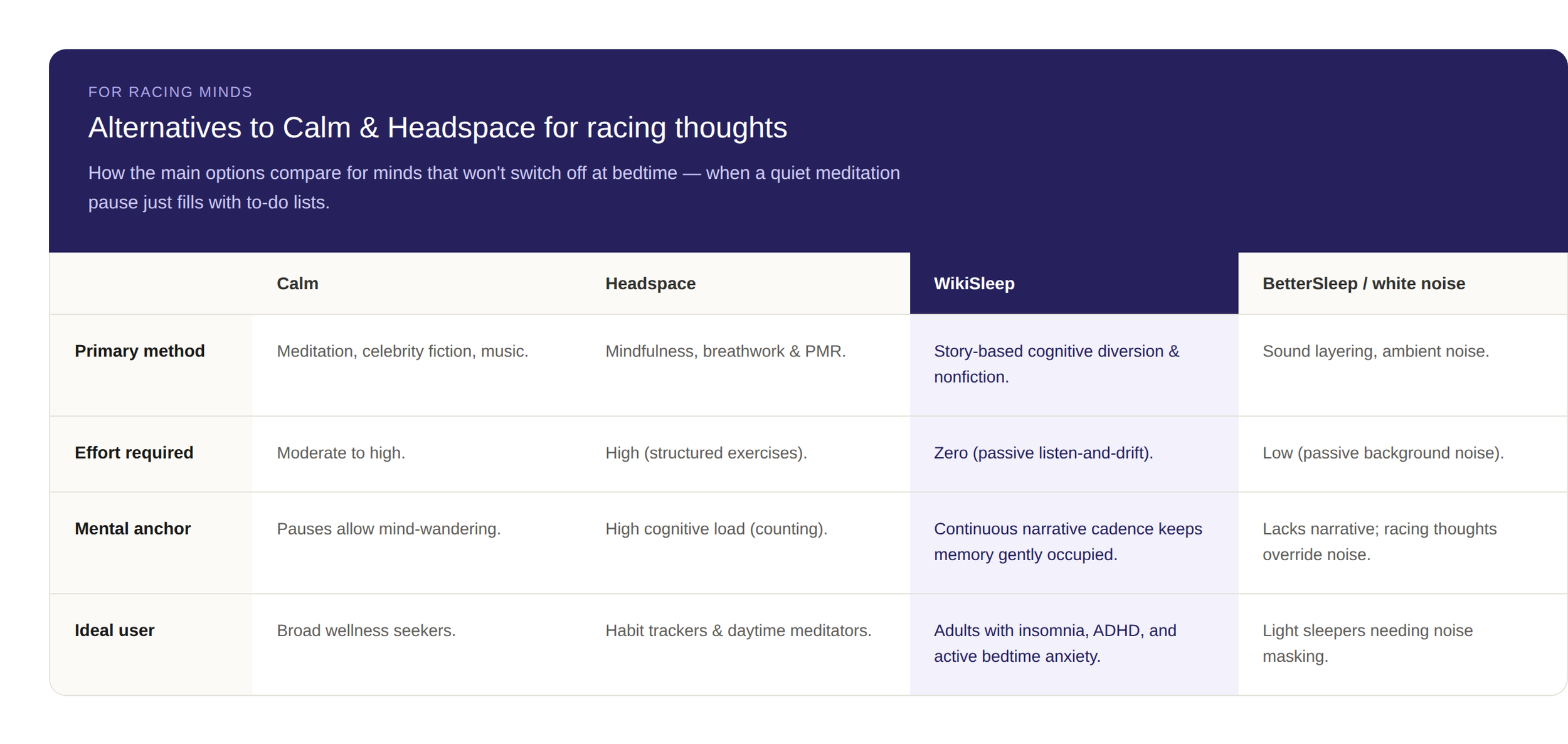
To break this cycle, sleep science in 2026 emphasizes passive mental engagement. Here is how the top categories compare when evaluated for cognitive hyperarousal:
1. WikiSleep (Story-Based Cognitive Diversion)
Unlike Calm's high-production celebrity fiction that can sometimes be too stimulating, or Headspace's structured breathing drills, WikiSleep is built specifically around deeply researched, calm nonfiction. By telling historically rich, low-stakes stories, the app keeps working memory occupied until sleep naturally takes over. Narration is scientifically calibrated to a steady cadence of ≤ 90 words per minute (wpm), encouraging parasympathetic dominance and slowing brainwave patterns from alert Beta down to Delta-wave deep sleep.
2. Sleep Reset (CBT-I)
For users who need structural behavioral changes, Sleep Reset offers a digital Cognitive Behavioral Therapy for Insomnia (CBT-I) program. Rather than focusing on meditation, it utilizes sleep restriction and circadian retraining to rebuild the body's natural sleep drive.
3. Loóna and Sensory Wind-Down Tools
Loóna provides visual and atmospheric sleep tools designed for sensory wind-down. By combining interactive 3D coloring with storytelling, it focuses on transitioning the mood rather than enforcing breath exercises.
Sleep Apps for People Who Suck at Mindfulness
For adults who find mindfulness frustrating, apps like WikiSleep and other narrative sleep story platforms are vastly superior to traditional meditation tools. Mindfulness apps require active attention and body tracking—cognitive tasks that often trigger performance anxiety in restless sleepers. If you find yourself searching for a tool to simply "help me to fall asleep" without assigning you mental homework, you need an approach based on Cognitive Diversion rather than meditation.
Pioneered by cognitive scientist Dr. Luc P. Beaudoin, Cognitive Diversion (or Serial Diverse Imagining) replaces structured problem-solving with a continuous stream of emotionally neutral imagery. As Dr. Karan Rajan notes, cognitive disruption techniques act as a "biological version of turning the power button off and on," breaking the dreaded cycle of overthinking by eliminating active conscious choice (Archyde).
Meditation requires active mental discipline, whereas falling asleep requires mental surrender; story-based cognitive diversion acts as the bridge between an overactive mind and effortless rest. By listening to calm nonfiction stories—such as ancient history or biographies—the Default Mode Network (responsible for rumination) is downregulated, nudging the brain into the disorganized, dreamy hypnagogic state characteristic of Stage 1 NREM sleep.
Apps to Help You Sleep That Aren't Just Guided Meditation
If you want an effective sleep app that avoids guided meditation entirely, the best alternatives include curated nonfiction narratives, cognitive word shufflers, and soundscape mixers. While meditation demands introspection, these categories rely on external acoustic anchors.
Curated Nonfiction & Bedtime Stories: WikiSleep leads this space by offering adult-tailored historical, biographical, and travel narratives with zero mindfulness exercises attached. Professional sound normalization ensures stories never suffer from jarring volume jumps that trigger nocturnal startle responses.
Cognitive Shuffling Tools: Apps like Drift offer serial diverse imagery generation, feeding the brain random, unrelated words to scramble rumination patterns naturally.
Soundscape Mixers: Apps like BetterSleep provide customizable noise profiles, such as brown noise and solfeggio frequencies, to mask environmental disruptions.
While white noise is popular, recent data highlights the superiority of narrative audio. According to a randomized crossover trial, adults listening to low-stimulus, low-arousal narrative audio fell asleep 38% faster compared to conventional broadband white noise (Beresford et al., 2023 / SleepCalculators 2025).
Finding the Right Sleep App in 2026
The landscape of digital sleep wellness has permanently shifted. We now understand that for neurodivergent individuals and those with racing minds, forcing mindfulness creates more problems than it solves. If you are struggling with nighttime anxiety, a passive, diversion-based sleep app will be far more effective than forcing yourself to meditate. By eliminating sleep effort and replacing breath-counting with fascinating, paced narratives, you can finally outsmart your overactive mind and achieve the deep, restorative rest you deserve.