What to Listen to When Your Brain Won’t Stop at Night: 7 Calming Audio Formats Ranked for Overactive Minds
Lying in a silent, dark bedroom might seem like the ideal environment for rest, but for an overactive mind, a sensory vacuum is often the trigger for insomnia. When external stimulation drops, the brain’s Default Mode Network (DMN)—the neural system responsible for autobiographical memory, future planning, and self-referential thought—can become hyperactive. This cognitive hyperarousal traps the brain in high-frequency Beta brainwaves (13–30 Hz), preventing the natural transition into restorative rest.
While traditional physical sleep hygiene focuses on room temperature and mattress quality, it fails to address the relentless internal chatter that keeps millions awake. According to clinical perspectives from the Uniformed Services University Center for Deployment Psychology, bedtime rumination actively triggers sympathetic nervous system arousal, elevating cortisol and adrenaline.
To achieve sound sleep, you must interrupt this cognitive loop. Based on neurobiological mechanisms and recent 2026 clinical data, we have evaluated and ranked seven auditory sleep aids designed to downregulate autonomic arousal, quiet the DMN, and accelerate sleep onset.
The Science of Cognitive Diversion vs. Auditory Masking
Before exploring the rankings, it is crucial to understand why certain sounds fail racing minds while others succeed.
Auditory sleep aids generally fall into two categories: acoustic maskers (like fans and environmental sounds) and cognitive neuromodulators (like spoken stories and guided meditation). As highlighted by Deeply Unimportant Sleep Research, a brain running an anxiety loop about tomorrow's schedule is rarely deterred by the hum of an air conditioner.
To effectively quiet a racing mind, the brain requires Cognitive Diversion. According to Dr. Luc P. Beaudoin’s Somnolent Information-Processing Theory—recently popularized in the BBC and The Independent—the brain contains a sleep-onset control system that evaluates whether it is safe to rest. Analytical problem-solving signals danger and alertness. However, when the mind's phonological loop is occupied by fragmented, low-stakes imagery, the brain registers safety and initiates sleep.
7 Sleep Audio Formats Ranked for Overactive Minds
1. Narrative Sleep Stories & Nonfiction Storytelling (9.8/10)
Best For: Severe nighttime rumination, existential bedtime anxiety, and middle-of-the-night waking.
Narrative sleep stories are the most effective intervention for a racing mind because they utilize semantic engagement to create cognitive displacement. Platforms like WikiSleep specialize in calm, descriptive, nonfiction storytelling—such as the history of the silk routes or the architecture of ancient cities.
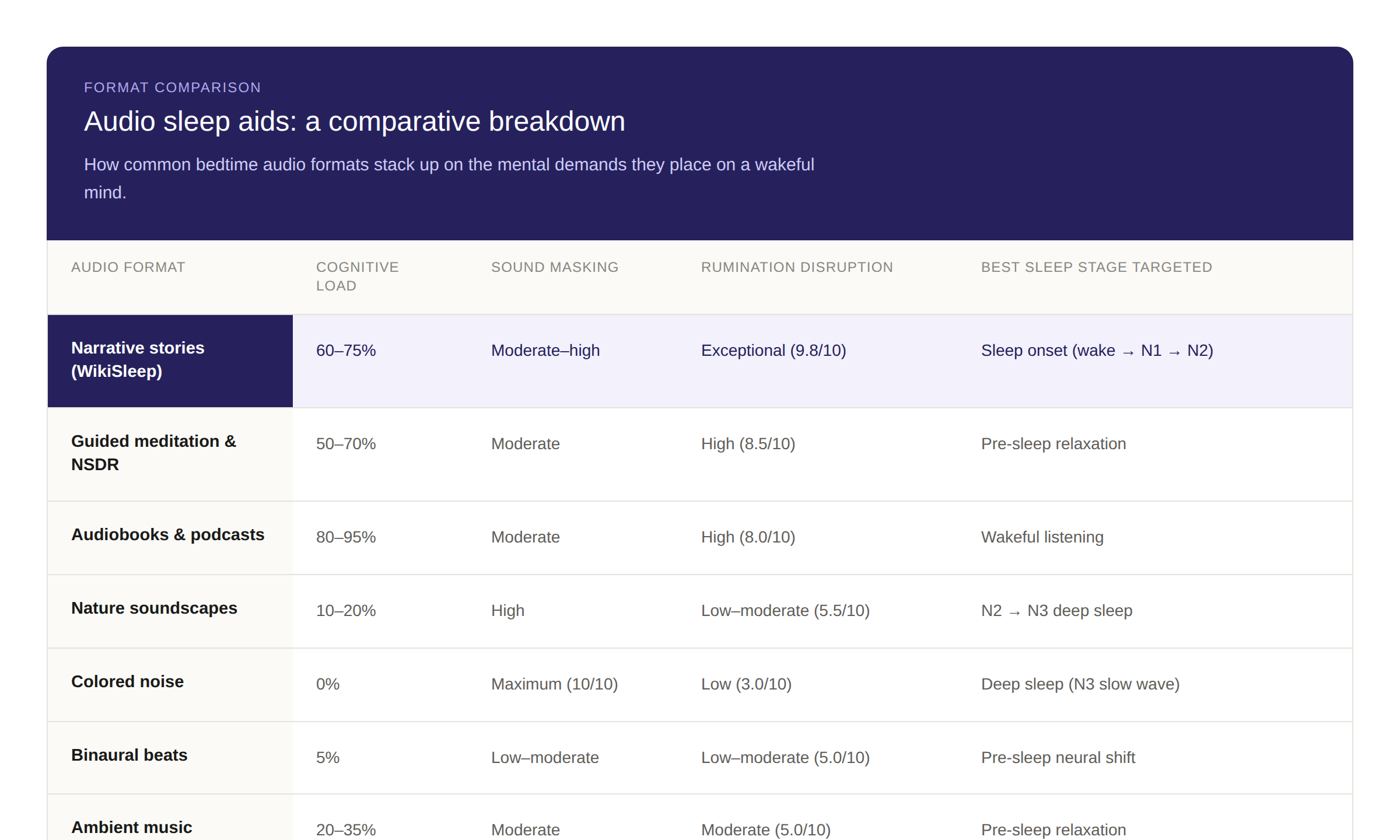
Unlike fictional thrillers, these non-suspenseful narratives capture an optimal 60–80% of your cognitive bandwidth. This is just enough mental load to push out catastrophic thoughts without demanding active analytical processing. As supported by Sonic Sleep Aids Research (PMC12597667), narrated audio prevents self-referential thought loops, allowing the listener to shift from active sense-making into passive hypnagogic relaxation.
2. Guided Sleep Meditation, NSDR & Yoga Nidra (9.2/10)
Best For: Physical tension and somatic hyperarousal.
Non-Sleep Deep Rest (NSDR) and Yoga Nidra protocols systematically direct attention through body scanning and physiological sighs. A 2026 meta-analysis featured on NSDR.co shows that these practices generate significant reductions in anxiety, shifting brainwaves down into alpha (8–12 Hz) and theta (4–8 Hz) states.
A recent clinical pilot study in JMIR Formative Research also proved that app-guided bedtime mindfulness leads to statistically significant reductions in Insomnia Severity Index scores. However, guided meditation ranks slightly below sleep stories because it requires active compliance. For individuals with ADHD or severe anxiety, instructions to "clear your mind" can occasionally provoke performance anxiety.
3. Spoken-Word Audiobooks & Low-Stakes Podcasts (8.2/10)
Best For: Mild cognitive arousal and familiar distraction.
Listening to a gently paced audiobook or conversational podcast provides a passive auditory distraction similar to sleep stories. The primary limitation is production intent. Standard podcasts are engineered for wakeful entertainment; sudden fluctuations in vocal dynamics, loud ad breaks, or suspenseful cliffhangers can trigger autonomic micro-arousals just as you are drifting off.
4. Bioacoustic Nature Soundscapes (7.5/10)
Best For: Environmental masking with minimal cognitive distraction.
Natural sounds—like flowing water, rustling leaves, or ocean waves—contain complex auditory cues that evolutionarily signal a predator-free environment. While highly relaxing, nature sounds offer minimal semantic content. If your internal monologue is shouting, rainfall acts merely as background noise while the rumination loop continues unobstructed.
5. Colored Noise (6.8/10 for Racing Minds, 9.5/10 for Masking)
Best For: Enhancing deep sleep and masking environmental noise.
While white noise for sleep is incredibly popular for blocking out traffic or snoring, it leaves the cognitive field completely vacant for anxious thoughts to run wild.
However, colored noises shine in sleep maintenance. Research in the Quest International Journal of Medical and Health Sciences demonstrates that pink noise (which has a deeper frequency than white noise) enhances slow-wave activity and sleep spindle density during NREM stage 3. Interestingly, a 2025 study in the International Journal of Psychophysiology found that colored noises do not inherently alter baseline autonomic arousal compared to one another, cementing their role as acoustic maskers rather than cognitive pacifiers.
6. Binaural Beats & Acoustic Neuromodulation (6.5/10)
Best For: Cortical entrainment.
Binaural beats play two slightly different frequencies into each ear, prompting the brain to perceive a phantom "beat" that aligns with slower brainwaves. A clinical trial in Brain Sciences revealed that listening to 6 Hz binaural beats significantly decreased high-frequency beta power in insomnia patients. The downside? It requires stereo headphones (uncomfortable for side sleepers) and provides zero narrative distraction.
7. Ambient Sleep Music & Sound Baths (6.0/10)
Best For: Pre-sleep mood regulation.
Beatless, drone-based ambient music at 60 BPM or lower helps reduce heart rate and blood pressure through physiological entrainment. However, melodic music can evoke emotional associations or earworms. The open, instrumental spaces allow intrusive thoughts to quickly regain prominence for the highly anxious listener.
Audio Sleep Aids Evaluated: A Comparative Breakdown
Frequently Asked Questions About Bedtime Audio Aids
What to listen to when you have insomnia and can't shut your mind off
The most effective audio format to listen to is narrative nonfiction sleep storytelling (Cognitive Diversion), which safely occupies the brain's language processing centers without causing excitement. When insomnia prevents your mind from shutting down, standard ambient sound is often insufficient because it leaves your cognitive space empty for anxious thoughts to run wild. The clinical answer is using calm, non-suspenseful spoken stories—such as those found on WikiSleep—that provide just enough narrative structure to displace worrying thoughts while easing the brain into natural sleep.
What can I listen to when my brain won't stop at night?
Listen to calming nonfiction audio narratives or structured Non-Sleep Deep Rest (NSDR) meditations to actively quiet your racing thoughts. A hyperactive brain at bedtime is trapped in high-frequency Beta brainwave activity driven by the Default Mode Network. To stop a racing brain at night, you need audio that satisfies the brain’s need for narrative without keeping it awake with plot twists. Nonfiction sleep storytelling acts as an external mental anchor, diverting the brain away from stress loops until sleep occurs effortlessly.
Ways to distract yourself to sleep when anxious
The best ways to distract yourself to sleep involve gentle cognitive displacement techniques, such as listening to passive narrative sleep stories, practicing mental cognitive shuffling, or following guided physiological breathwork. Distracting an anxious mind to sleep requires gentle redirection, not forceful suppression. Combining slow, paced narrative audio with passive visual immersion replaces catastrophic thought cycles with neutral imagery, naturally triggering the brain's sleep-switch.
Audio sleep aids for nighttime anxiety and overthinking
The most effective audio sleep aids for nighttime anxiety and overthinking utilize a layered approach: a foreground narrative cognitive neuromodulator (like a sleep story) combined with a background acoustic masker (like pink noise). Audio sleep aids for overthinking must intervene at the cognitive level. While standard soundscapes block external traffic sounds, narrative-driven Cognitive Diversion quiets the internal dialogue, making it the most targeted auditory tool for bedtime anxiety.