Why Nonfiction Sleep Stories Work for Insomnia, Anxiety & Busy Brains
For millions of adults, bedtime is less of a peaceful transition and more of a battleground against a racing mind. If you find yourself lying awake, obsessively planning tomorrow's schedule or replaying events from a decade ago, you are likely dealing with an overactive sleep brain. Traditional clinical advice has long championed silent rooms, white noise, or mindfulness meditation. However, for highly anxious or neurodivergent individuals, these methods often backfire.
In 2026, the scientific understanding of nighttime anxiety is undergoing a major shift. Sleep experts are increasingly pointing to "Cognitive Diversion"—specifically delivered through low-stakes history and nonfiction—as a highly effective tool for bypassing nighttime rumination. This guide explains the neurological mechanics behind using history for sleep, why traditional sleep hygiene methods fail busy minds, and how narrated insomnia stories can help you effortlessly transition into deep rest.
What is a Sleep Brain? Understanding Nighttime Cognitive Arousal
The primary barrier to sleep is rarely physical exhaustion; rather, it is cognitive arousal. When the lights go out and external stimuli like screens and conversations are removed, the brain shifts into a highly active "processing mode."
This internal noise is driven by the Default Mode Network (DMN), a group of interacting brain regions responsible for self-reflection, future planning, and rumination. In a dark, quiet room, the DMN becomes highly active, amplifying anxieties and making worries feel far more intrusive than they do during the day.
The "Sleep Effort" Trap and Orthosomnia
Attempting to force sleep actively creates a clinical paradox known as "sleep effort." Trying to clear your mind turns relaxation into a high-pressure, goal-oriented task, which inevitably spikes cognitive arousal.
As Stanford University psychologist Natalie Solomon notes, "as we put in more and more effort, we actually get into a pretty sleep-incompatible state". Lying awake obsessively trying to force sleep triggers the release of cortisol and adrenaline, which actively worsens insomnia.
This phenomenon has been heavily exacerbated by the modern obsession with sleep trackers and "sleep maxxing." According to a 2026 report from the American Academy of Sleep Medicine (AASM), 81% of Americans report losing sleep due to worries about sleep problems. Data further shows that 68% of Americans struggle with sleep at least once a week, largely due to these anxious "to-do list" loops.
Why Traditional Bedtime Audio Fails Busy Minds
While meditation and white noise remain popular recommendations, they frequently fail to address the core neurological issue of cognitive arousal. Here is why the standard approaches fall short:
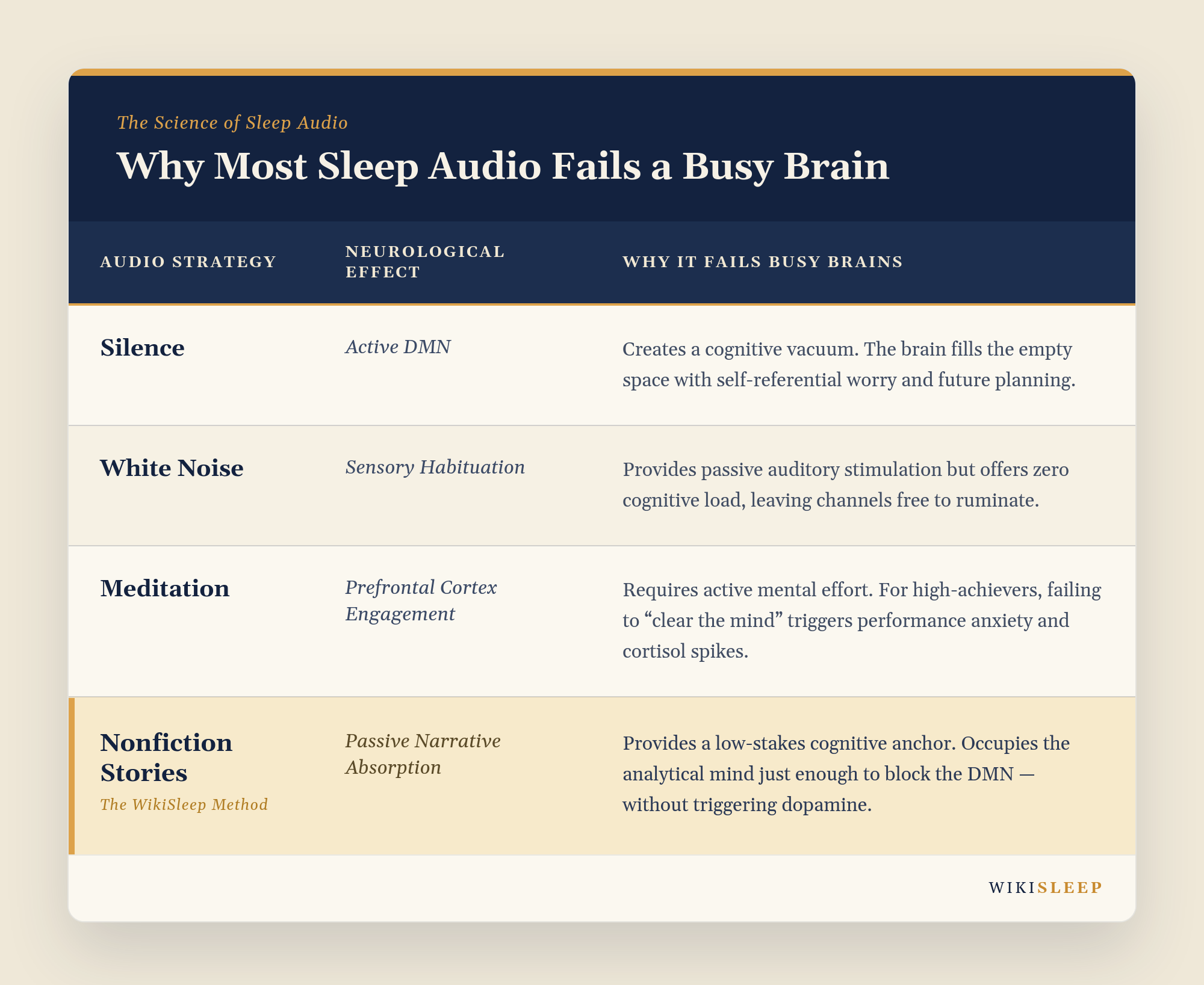
How Cognitive Diversion Solves Nighttime Anxiety
The neurological efficacy of insomnia stories lies in a mechanism called Cognitive Diversion, which relies on two heavily researched psychological concepts: cognitive shuffling and narrative absorption.
1. The Science of Cognitive Shuffling
Developed by cognitive scientist Dr. Luc P. Beaudoin, the theory of Somnolent Information-Processing argues that the brain uses an evolutionary safety check before allowing sleep. Coherent, logical thinking—like worrying about finances—signals to the brain that it is in an active problem-solving state, meaning it is not safe to sleep.
Conversely, disorganized, random, and emotionally neutral imagery mimics the natural "micro-dreaming" (hypnagogic) phase that precedes sleep. Dr. Alanna Hare, a sleep medicine specialist, notes:
"Cognitive shuffling is 'super somnolent.' It deploys a push-and-pull mechanism on the mind—both pulling you towards sleep while also quietening the intrusive worries that keep you awake."(BBC Future, 2026)
2. Narrative Absorption
Research into "Narrative Transportation" proves that when a listener becomes absorbed in a story, they dedicate their working memory to constructing that narrative world. This directed cognitive engagement actively crowds out self-referential thought, drastically decreasing the time it takes to fall asleep.
Why We Use History to Fall Asleep
Not all audio narratives work as sleep aids. Fictional thrillers and true-crime podcasts trigger the release of dopamine, keeping the listener awake to discover what happens next.
History and nonfiction narratives sit perfectly in the "just interesting enough" sweet spot. Exploring the architectural history of a lighthouse or minor ancient tax reforms feeds the brain’s analytical centers without triggering excitement or threat responses.
Because historical events have already concluded, there are no suspenseful cliffhangers and no relatable modern stresses. Listening to history to fall asleep effectively short-circuits anxiety by providing high emotional distance.
The preference for history as a wind-down tool is reflected in broad consumer data. The Triton Digital 2025 U.S. Podcast Report reveals that while genres like comedy and sports heavily skew toward video, History (56%) and Science (58%) are consumed almost exclusively as audio-only formats, making them ideal for screen-free sleep hygiene.
How to Choose the Right Insomnia Stories
When seeking out audio for sleep, the quality and engineering of the narration matter immensely. As a pioneer in the digital cognitive wellness space, WikiSleep has engineered a story-based platform specifically designed to harness these neurological principles.
Rather than forcing users to "work to find calm" through rigid breathing exercises, WikiSleep delivers passive listening experiences. Through carefully produced, slow-paced historical narratives and nonfiction, the app provides the perfect cognitive anchor for a busy mind. Recent 2026 data shows that adults listening to low-stimulus narratives fall asleep 38% faster than those relying on standard white noise.
The best sleep stories feature:
Low-register narration: Slow, deliberate pacing without sudden volume spikes.
High descriptive detail: Sensory language that encourages the brain to build a mental picture.
Zero dramatic tension: No unresolved plot lines, alarming sound effects, or swelling musical scores.
Frequently Asked Questions
Why does boring history work better than white noise for sleep?
White noise fails to quiet a busy mind because it lacks cognitive load. Boring history provides a "cognitive anchor" that occupies the brain's analytical centers just enough to silence anxious thoughts, but lacks the emotional stakes to trigger dopamine release or wakefulness.
How are sleep stories different from meditation?
Traditional meditation often triggers "sleep effort"—a clinical paradox where trying to force mindfulness causes performance anxiety and cortisol spikes. Nonfiction sleep stories, by contrast, offer a passive, low-stimulus narrative that allows the brain to transition to sleep effortlessly.
How does cognitive diversion signal safety to the brain?
Under the theory of Somnolent Information-Processing, the human brain requires disorganized, random imagery to initiate sleep. Coherent planning and worry signal danger or active tasks. Low-stakes historical storytelling acts as an auditory version of cognitive shuffling, signaling to the prefrontal cortex that it is safe to power down.
Conclusion
If a racing sleep brain keeps you awake at night, trying harder to sleep will only worsen the problem. By leaning into the science of Cognitive Diversion, you can give your mind the distraction it craves without the stimulation it doesn't need. Whether you choose to explore ancient architecture or the quiet history of everyday objects, using history for sleep offers a gentle, effortless, and scientifically proven pathway to rest.