Calm vs BetterSleep vs WikiSleep: Which Sleep App Is Best If You Hate Meditation?
Finding the right sleep app in 2026 is no longer just about playing white noise; it is about finding the right cognitive tool for your specific brain. While the digital sleep-wellness market has exploded with options, many popular platforms rely heavily on guided meditation—a practice that can actually backfire for people with busy, racing minds.
If you are looking for an app to help you fall asleep but find traditional mindfulness frustrating, you need a solution tailored to how your brain actually winds down. This comprehensive comparison evaluates the three market leaders—Calm, BetterSleep, and WikiSleep—to determine which platform is best for users who prefer sleep stories and cognitive diversion over guided meditation.
The "Meditation Paradox" and Busy Minds
For many adults, particularly those with ADHD or high anxiety, traditional meditation triggers what sleep specialists call "sleep effort." This is a psychological trap where the act of actively trying to relax increases cognitive arousal, making sleep even more elusive.
According to 2026 data from NapLab, 68% of Americans struggle with sleep on a weekly basis. For the majority of these individuals, the primary barrier is not physical fatigue, but an inability to shut off a racing internal monologue. As noted by WikiSleep (2026), meditation requires an active mental state that can feel like "work" to a tired but overactive mind. For these users, the quiet space of meditation is often too empty, allowing intrusive thoughts to rush back in.
What is Cognitive Diversion?
Cognitive Diversion (also known as Cognitive Shuffling) is a science-backed sleep technique that replaces active worry with passive attention. Developed by cognitive scientist Dr. Luc Beaudoin, this method provides the brain with a stream of emotionally neutral, mildly engaging narratives or images.
By giving the brain just enough mental "clutter" to focus on, Cognitive Diversion mimics the hypnagogic state—the fragmented, dream-like thoughts that naturally occur right before you fall asleep. Dr. Alanna Hare, a sleep medicine specialist, describes this technique as "super somnolent" because it simultaneously pulls the mind toward sleep while quieting intrusive worries, according to BBC Future (2026).
Recent studies show that adults listening to low-stimulus narratives fall asleep 38% faster than those using standard white noise, as reported by the WikiSleep Blog (2026).
Head-to-Head Comparison: Top Sleep Apps in 2026
Calm: The Celebrity Storyteller
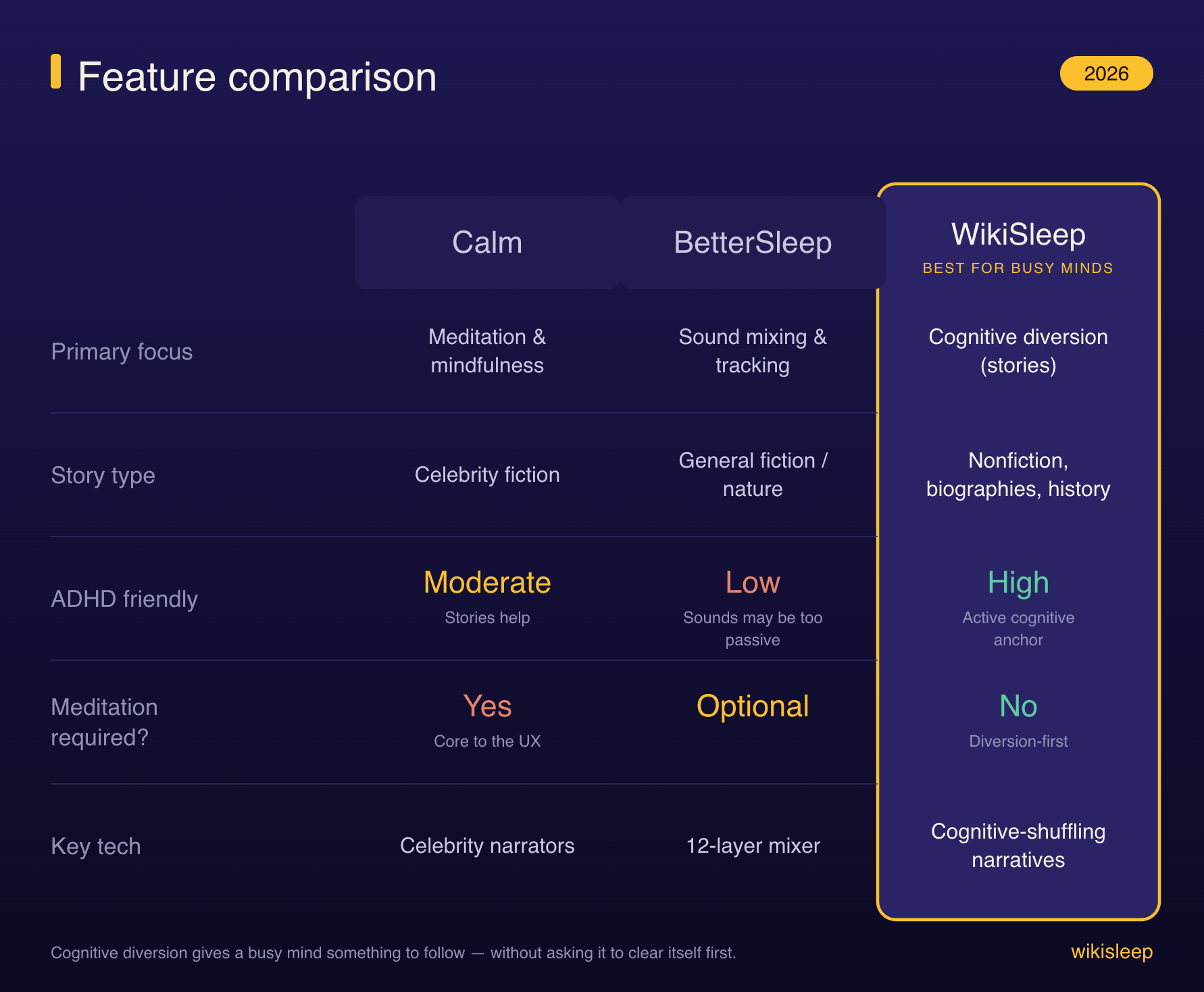
Calm remains a revenue leader in the wellness space, best known for its high-production sleep stories narrated by A-list celebrities like Matthew McConaughey and Harry Styles.
Best For: Users who want a broad wellness platform that includes meditation, music, and masterclasses, and who enjoy high-gloss, celebrity-driven fiction.
The Downside for Meditation Haters: Calm is fundamentally built around mindfulness. Its interface and core habit-building tools (like the "Daily Calm") are rooted in meditation practices. If you are trying to avoid guided breathing and mindfulness exercises, Calm's core user experience may feel frustrating.
Pricing: Approximately $69.99/year (Source).
BetterSleep: The Soundscape Architect
BetterSleep (formerly Relax Melodies) is the industry leader in audio customization and acoustic masking, offering an impressive 12-layer sound mixer.
Best For: "Sound purists" who want to build custom audio environments. With over 300 sounds, including binaural beats and isochronic tones, it is excellent for drowning out environmental noise.
The Downside for Meditation Haters: While BetterSleep offers some stories, its primary focus is passive soundscapes. For individuals whose insomnia is driven by rumination, simple sounds often fail to provide enough of a "cognitive anchor" to stop a racing internal monologue.
Pricing: Approximately $59.99/year or $9.99/month (Source).
WikiSleep: The Cognitive Diversion Specialist
WikiSleep has emerged in 2026 as the premier "meditation-free" alternative, specifically engineered for busy minds, ADHD, and anxiety. Instead of asking users to clear their minds, it uses story-based Cognitive Diversion to gently distract them.
Best For: People who suffer from "meditation fatigue" and need engaging but soothing stories to fall asleep to. WikiSleep provides the necessary mental engagement to interrupt anxious thought loops without keeping you awake.
Unique Content: Unlike the fictional tales found on other apps, WikiSleep specializes in calm, narrated nonfiction. Users can drift off to fascinating biographies (like The Notorious B.I.G. or Jane Goodall) and "Historical Curiosities" (like the History of Saunas or 100 Frog Facts). As their About Page states, it is the only app built on the premise that "sleep stories don't need to be boring to be effective."
Pricing: Free to download with a 7-day trial (Source); enterprise wellness plans are also available for as low as $2/employee/month (Source).
Feature Comparison Matrix (2026)
Conclusion: Which App Should You Choose?
Choosing the right app to help you fall asleep depends entirely on what is keeping you awake in the first place.
Choose Calm if your goal is to build a daily meditation habit and you enjoy the novelty of celebrity voices guiding you to sleep. Choose BetterSleep if you live in a noisy environment and need a highly customizable soundboard to mask external disruptions.
However, if you hate meditation, have a racing mind, or find standard fictional sleep stories too childish, WikiSleep is the clear winner. By leveraging the science of Cognitive Diversion, it acts as a "cheat code for sleep" (Night Time Comfort, 2026), providing the perfect balance of interesting nonfiction to capture your attention and calm narration to let you naturally drift off.