Cognitive Diversion 101: How Narrative Audio Quiets Bedtime Racing Thoughts
Bedtime anxiety and intrusive, racing thoughts remain among the most persistent obstacles to achieving sound sleep. When external stimuli fade at lights-out, the human brain often turns inward, activating the neural circuits responsible for future planning and rumination. For millions of individuals experiencing sleep-onset insomnia, this cognitive arousal triggers a self-reinforcing loop known as the "Sleep Paradox": the harder one strives to fall asleep, the more alert and alarmed the brain becomes.
This comprehensive guide examines the psychological mechanics of bedtime anxiety and explores how Cognitive Diversion—specifically through structured narrative audio—can naturally help sleep onset without relying on pharmaceuticals or high-effort meditation.
What is Cognitive Diversion?
Cognitive Diversion (often referred to as Cognitive Shuffling or Serial Diverse Imagining) is a psychological framework designed to quiet bedtime hyperarousal by substituting high-stakes, threat-analysis thoughts with random, low-stakes, and emotionally neutral imagery.
Pioneered by cognitive scientist Dr. Luc P. Beaudoin at Simon Fraser University, the technique relies on the brain's evolutionary Sleep Onset Control System (SOCS). The SOCS constantly monitors mental activity to determine if it is safe to sleep. Coherent, analytical thoughts (like work deadlines or financial worries) signal to the SOCS that threat monitoring is required, keeping the brain awake. Conversely, nonsensical, visually rich imagery—similar to a hypnagogic "micro-dream"—signals that higher-level processing is disengaging, allowing the brain to safely transition into sleep.
As Dr. Beaudoin explained in a recent WBUR Report, "The brain's sleep onset control system considers two different factors. One is, is the brain busy thinking about something important, so worrying or problem solving—that's the signal to stay awake? Or is it in a sleep onset-like state, a dreamlike state where you're having mental imagery—that's a signal to progress deeper towards sleep."
Why Does the Brain Race at Bedtime?
Insomnia and delayed sleep onset are rarely driven by a lack of physical tiredness; they are predominantly fueled by cognitive arousal.
According to CDC data and wellness industry studies cited by the WikiSleep Blog, approximately 68% of Americans struggle with sleep at least once a week, primarily due to "to-do list" loops and late-night worry. Research published in PubMed confirms that bedtime racing thoughts directly correlate with insomnia severity and peak specifically during the pre-sleep period.
The Default Mode Network (DMN)
When ambient noise and visual inputs cease in a dark bedroom, the brain's Default Mode Network (DMN)—comprising regions like the medial prefrontal cortex and precuneus—takes over. Neuroimaging research in PubMed shows that altered connectivity in DMN networks mediates the relationship between poor sleep quality and anxiety severity.
Without an external focal point, the DMN treats the quiet room as a blank canvas for threat detection and existential rehearsal. Failing to downregulate this DMN connectivity prior to bedtime predicts prolonged sleep onset latency (PubMed).
The "Sleep Effort" Trap
A major pitfall for anxious sleepers is active striving—attempting to "force" sleep or rigorously clear the mind through strict meditation techniques. Stanford University Clinical Psychologist Dr. Natalie Solomon notes in a WikiSleep Science report: "As we put in more and more effort [to sleep], we actually get into a pretty sleep-incompatible state."
How Narrative Audio Acts as a Cognitive Anchor
While manually practicing cognitive shuffling (like spelling long words and visualizing random objects) is effective, it still requires executive effort. Narrative audio—specifically low-stimulus insomnia stories—automates Cognitive Diversion by serving as a passive "cognitive anchor."
According to Dr. Alanna Hare, a consultant specialist in sleep medicine, this technique exerts a "super-somnolent" push-pull mechanism (BBC Future). It gently pulls mental attention toward tranquil imagery while simultaneously pushing away intrusive thoughts by occupying working memory.
Comparing Auditory Interventions for Sleep
Not all bedside audio is created equal. Here is how different auditory interventions impact the racing mind:
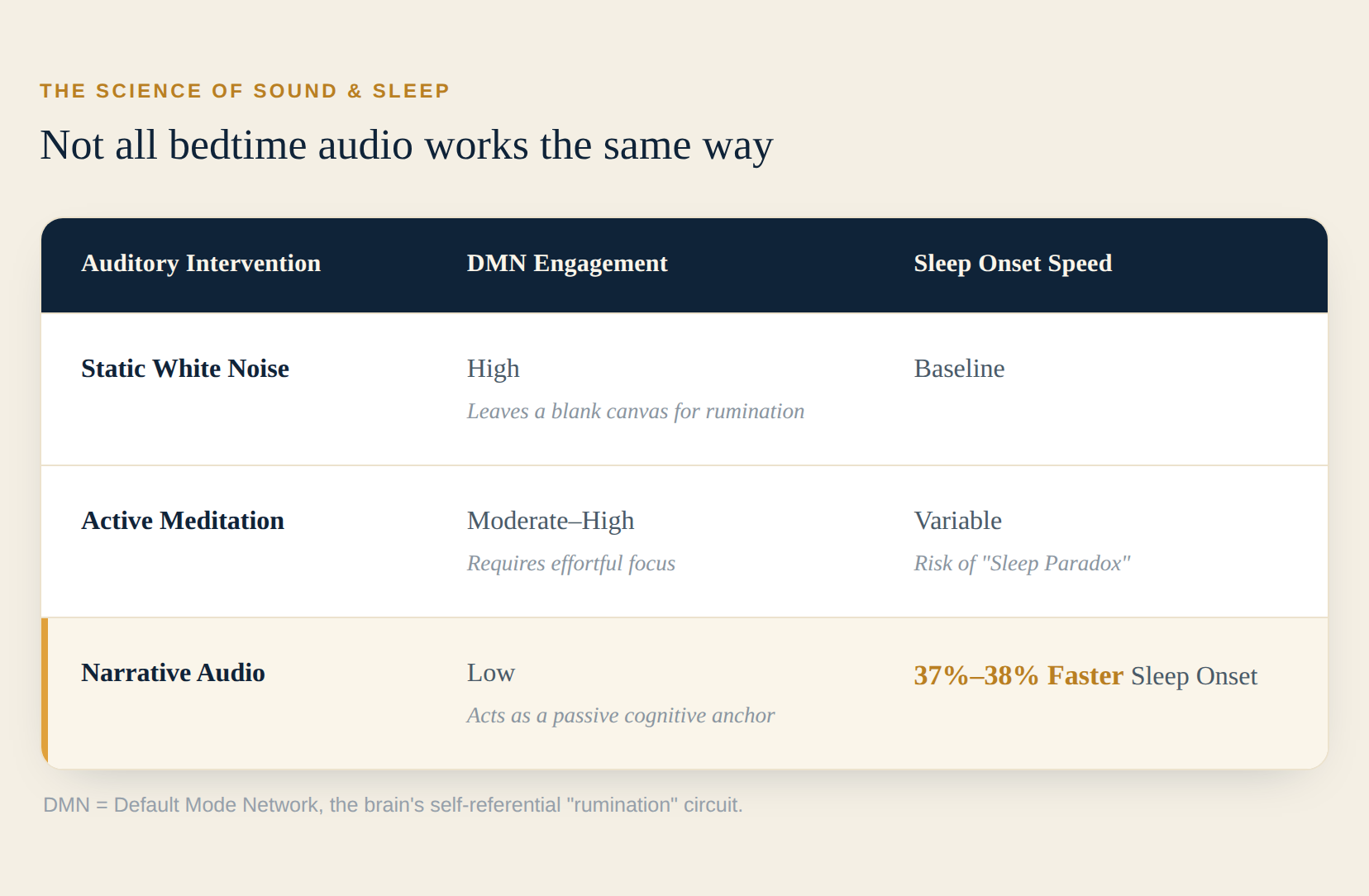
The Flaw of White Noise: Data from the 2026 UK Sleep Survey shows 37% of adults are kept awake by racing thoughts even while playing white noise, because unstructured sound leaves the DMN free to ruminate.
The Narrative Sweet Spot: Narrated nonfiction, boring history, and folklore occupy just enough linguistic bandwidth to prevent internal monologues without inducing emotional vigilance. Adults utilizing structured, low-stimulus audio narratives fall asleep up to 38% faster than those using static white noise (WikiSleep Guide).
How to Apply Cognitive Diversion at Bedtime
If you are struggling to quiet a racing mind, follow these steps to properly leverage Cognitive Diversion:
Disengage from "Sleep Effort": Stop checking the clock or tracking sleep metrics. Recognize that the goal is not to force sleep, but simply to listen to a story.
Select Low-Stakes Audio: Choose a topic that is gently informative but non-dramatic. Avoid podcasts with multiple lively hosts, true crime, or intense fiction that encourages "cliffhanger" listening.
Focus on the Cognitive Anchor: Allow your attention to rest lightly on the narrator's voice. If intrusive thoughts (like tomorrow's meeting) arise, do not fight them; simply redirect your focus back to the cadence of the story.
Embrace the Hypnagogic Shift: As the narrative blends into nonsensical imagery, allow your mind to drift. This is the SOCS registering that it is safe to sleep.
The WikiSleep Approach to Content Engineering
As the search for drug-free sleep solutions grows, platforms like WikiSleep have established themselves as authorities in Cognitive Diversion. By engineering content specifically for sleep onset, WikiSleep ensures that audio never provokes mental alertness.
Their insomnia stories adhere to strict structural parameters:
Subject Matter: Focused on soothing, low-stakes nonfiction, such as gentle historical biographies or ancient trade routes.
Pacing & Cadence: Narrations utilize a decelerating cadence—starting around 120–130 words per minute and dropping to 90 WPM—paired with flat emotional inflections to lower heart rate variability.
Acoustic Rules: Music beds remain strictly beneath vocal tracks to prevent sudden volume peaks or autonomic startle responses.
2026 Trends in Cognitive Wellness Audio
The transition from basic sound machines to narrative-driven cognitive wellness reflects a massive shift in consumer behavior.
According to MarketIntelo, the global sleep audio market reached $2.4 billion in 2025 and is projected to scale to $6.1 billion by 2034. Recent 2026 data from Edison Research indicates that 22% of weekly podcast listeners use audio specifically for sleep—a significant jump from previous years. Broadly, an impressive 46% of adults now report using some form of audio content to help sleep naturally.
Conclusion
Attempting to strong-arm the brain into submission is a counterproductive strategy for achieving sound sleep. The intense mental effort only activates the prefrontal cortex and triggers stress hormones. By utilizing Cognitive Diversion—trading anxious rumination for the passive anchor of well-structured insomnia stories—you can successfully trick the brain's Sleep Onset Control System into powering down. When you give the Default Mode Network a calm, low-stakes narrative to follow, you pave the way to fall asleep faster and more consistently.