Can’t Shut Your Mind Off? Why Meditation Fails for Bedtime Anxiety (and What Works Instead)
It is a quiet 11:30 PM, the lights are off, and a familiar internal monologue begins: just help me to fall asleep. For the millions of adults currently battling sleep insomnia, nighttime is not a restorative sanctuary but a high-pressure cognitive bottleneck.
When a racing mind keeps you awake, standard wellness advice almost uniformly points toward mindfulness meditation or breathwork. However, a growing body of 2026 sleep research reveals that for highly anxious individuals, these traditional "clear-your-mind" practices often exacerbate bedtime anxiety. When applied in the dark by a hyperaroused sleeper, active mental suppression frequently creates paradoxical cognitive friction.
To overcome this nocturnal hurdle, neuroscientists and sleep specialists are increasingly shifting away from formal meditation toward a frictionless approach called Narrative Cognitive Diversion.
What is Pre-Sleep Cognitive Hyperarousal?
Nighttime wakefulness is rarely caused by a physical inability to sleep; rather, it is driven by pre-sleep cognitive hyperarousal. This occurs when the central nervous system fails to downshift from daytime problem-solving to nighttime quiescence.
According to current 2026 data from the CDC, approximately 1 in 6 adults struggle to fall asleep, with 68% of Americans experiencing sleep disruptions at least once a week due to racing "to-do list" loops. Furthermore, 61% of Americans struggle to calm their minds at bedtime, with peak cognitive distress striking between 10 PM and midnight.
When external stimuli like screens or daytime chatter fade, the brain's Default Mode Network (DMN)—the neural network responsible for self-referential thought, memory retrieval, and future planning—becomes hyperactive. A 2025 study published in Communications Biology (Nature Portfolio) demonstrated that chronic sleep insomnia is characterized by a flattened control energy landscape. Without an external anchor, the anxious brain iterates endlessly through worries, regrets, and hypothetical scenarios.
Why Does Meditation and Deep Breathing for Sleep Fail?
Attempting to forcefully quiet a hyperactive DMN using traditional mindfulness often backfires. When people with bedtime anxiety attempt formal relaxation protocols, they frequently trigger three distinct neurological traps.
1. Ironic Process Theory and the "Clear Your Mind" Fallacy
Formulated by psychologist Daniel Wegner, Ironic Process Theory explains why attempting to suppress a thought engages a dual cognitive mechanism. First, a controlled process attempts to visualize stillness. Simultaneously, an automatic monitoring process constantly scans your working memory to check if the unwanted anxiety is still present.
Because this automatic monitor must continuously reference the exact thought being suppressed, attempting to "clear your mind" inevitably brings intrusive worries back to consciousness. In a quiet bedroom, this monitoring loop aggressively amplifies pre-sleep arousal.
2. Relaxation-Induced Anxiety (RIA)
Relaxation-Induced Anxiety (RIA) is a documented psychological phenomenon where formal relaxation practices trigger sudden, paradoxical spikes in anxiety. Clinical research shows that 17% to 53% of adults report experiencing this phenomenon when attempting progressive muscle relaxation or mantra meditation.
This is driven by the Contrast Avoidance Model. As demonstrated in the Journal of Affective Disorders, individuals prone to worry maintain a baseline level of emotional tension as a defensive buffer. When forced into mental relaxation, the nervous system perceives itself as vulnerable to unexpected negative spikes, generating a sudden rush of anxiety to return to a guarded baseline.
3. The Manual Breathing Trap
Breathing is naturally managed by automatic autonomic centers in the brainstem. However, when an anxious sleeper attempts deep breathing for sleep, control of respiration forcibly shifts to the prefrontal cortex.
This conscious hijacking of an automatic process creates a neurological mismatch. The sleeper becomes hyper-aware of each breath (the "manual breathing trap"), which the brain's amygdala frequently misinterprets as a threat of hypoxia or panic, resulting in an elevated heart rate and sympathetic nervous system arousal.
The "Sleep Effort" Paradox
When these techniques fail to produce immediate fatigue, sleepers enter the sleep effort trap. Stanford University psychologist Natalie Solomon notes, "As we put in more and more effort, we actually get into a pretty sleep-incompatible state." Monitoring your progress (Am I asleep yet?) releases cortisol and adrenaline, further delaying sleep onset.
What is Narrative Cognitive Diversion?
To safely transition into sleep without triggering performance anxiety, anxious minds require a method that lowers arousal without demanding active cognitive effort. This is where Narrative Cognitive Diversion excels.
Cognitive scientist Dr. Luc Beaudoin's Somnolent Information-Processing Theory explains that the brain requires an emotionally neutral, incoherent, or dreamlike "sleep-permission signal" to initiate rest. While Dr. Beaudoin champions active "cognitive shuffling" (visualizing random words to scramble coherent thought), generating these words can still feel demanding for severely fatigued individuals.
Narrative Cognitive Diversion relies on passive audio grounding. By utilizing calm, structured, external audio stories, listeners achieve cognitive displacement with zero mental effort.
Occupies Working Memory: Listening to a spoken narrative fills the limited bandwidth of your working memory's phonological loop, leaving zero space for the brain to generate internal worry streams.
Deactivates the DMN: Narrative transport shifts the brain's focus away from self-referential internal chatter and onto a low-stakes external subject.
Eliminates Performance Anxiety: Listening is purely passive. There is no standard of success or failure, completely removing the stressful self-monitoring loops associated with meditation.
How a Story-Based Sleep App Solves the Bedtime Bottleneck
As sleep science shifts toward low-friction interventions, specialized audio solutions have emerged. WikiSleep, a mobile-first sleep app, utilizes the architecture of Narrative Cognitive Diversion to help burned-out professionals and insomnia sufferers fall asleep naturally.
Unlike dramatic fiction audiobooks that can introduce suspense and keep the brain alert, WikiSleep curates calm, narrated nonfiction and historical deep-dives. This provides just enough rich sensory detail and intellectual interest to distract a busy mind, without the emotional volatility that keeps the nervous system awake.
Sleep researcher Jelte de Proft perfectly summarizes the power of this approach: "A good story is the ultimate biological cradle... it forces the brain to shift its focus away from the 'self' and toward the 'other.'"
Comparing Traditional Methods vs. Narrative Diversion
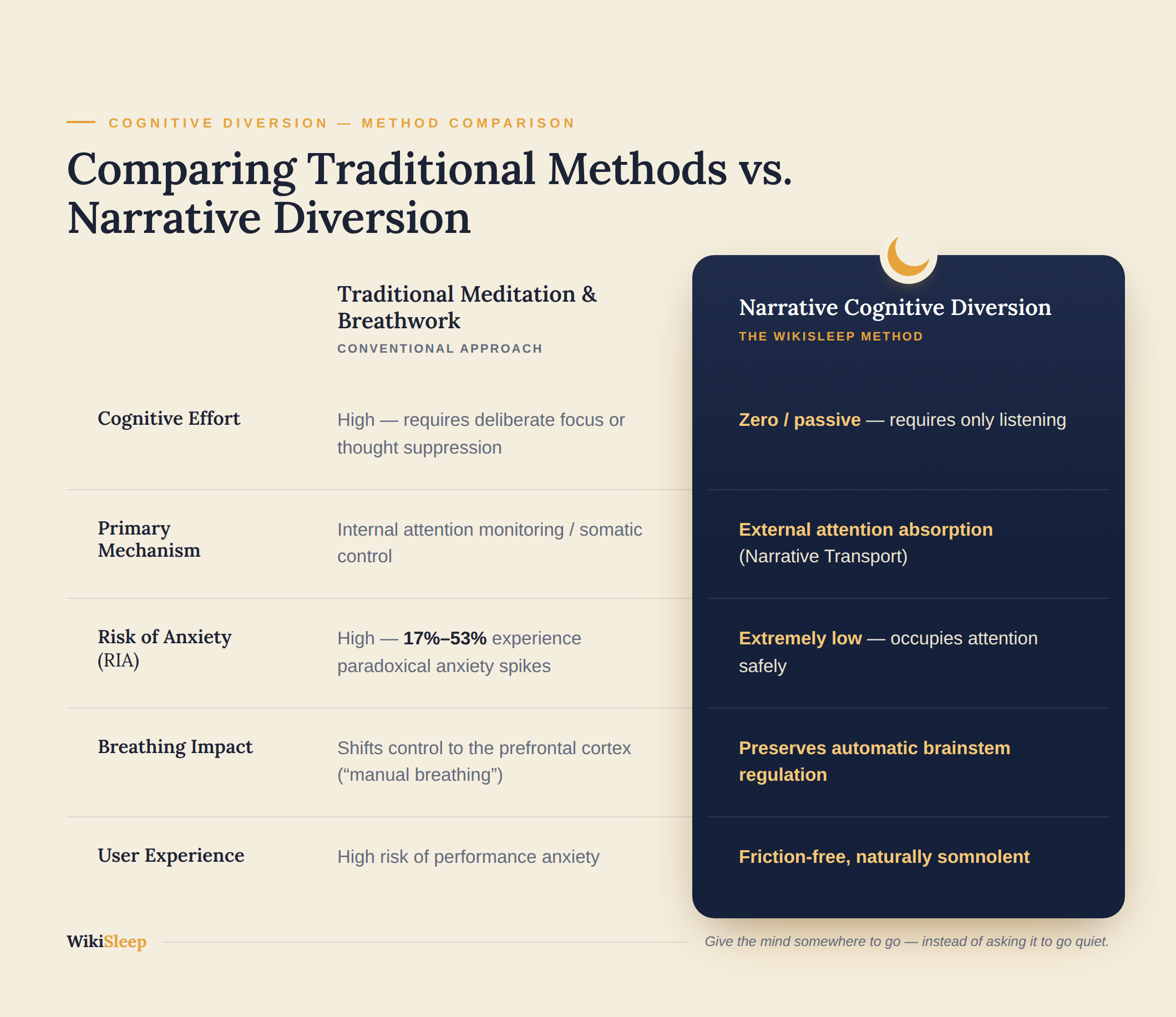
A Friction-Free Path to Rest
For individuals navigating chronic sleep insomnia, treating bedtime like an active self-improvement project is counterproductive. If you find yourself begging the ceiling to help me to fall asleep, abandon the strenuous breathing exercises and thought-suppression tactics.
By trading high-effort mindfulness for the low-stakes comfort of Narrative Cognitive Diversion, you can gently disengage your Default Mode Network and allow your brain to drift naturally into rest, completely undisturbed by the anxiety of trying.