Adult Sleep Stories That Don't Require Mindfulness: The Ultimate Non-Meditation Guide
For millions of adults suffering from bedtime anxiety and insomnia, mainstream sleep advice often backfires. When overstimulated minds are instructed to focus on their breath or perform a mental body scan, the result is rarely relaxation. Instead, these active mindfulness techniques can trigger frustration, heightened alertness, and even panic. Fortunately, there is a highly effective, science-backed alternative: non-meditation audio. By using relaxing sleep stories for adults, listeners can effortlessly distract their anxious minds and transition into deep rest.
This guide curates the best non-meditation sleep audio solutions and explains why engaging storytelling is the ultimate tool to fall asleep to.
Why Traditional Mindfulness Fails Many Sleepers
While meditation is a powerful tool for daytime stress management, using it as a sleep aid demands executive cognitive function—the exact opposite of what the brain needs to initiate sleep. Falling asleep requires the central nervous system to downregulate control and drift into passive, unstructured thought.
Clinical evidence shows that structured relaxation techniques can actively prevent sleep for a significant segment of the population. According to research published in the International Journal of Cognitive Therapy, Relaxation-Induced Anxiety (RIA) affects between 15% and 30% of individuals undergoing formal relaxation training (Luberto et al., 2021). For individuals prone to anxiety, directives to "focus on your breath" force attention onto internal physiological cues, which the nervous system can misinterpret as a threat signal.
Furthermore, a 2025 study in Brain Sciences demonstrated that trying to forcefully control or judge a pre-sleep state directly predicts insomnia severity (Fabbri et al., 2025). When anxious sleepers attempt to clear their minds, they engage in high-level executive monitoring. As the sleep engineering principle notes, sleep is a paradox: the harder you try, the harder it gets.
What is Cognitive Diversion?
Cognitive Diversion is a neuro-behavioral strategy that passively redirects linguistic and analytical processing away from personal worries by providing the prefrontal cortex with a low-arousal, external anchor.
Instead of asking the brain to perform internal work like breath counting, Cognitive Diversion uses engaging but neutral external stimuli—such as a well-narrated nonfiction story—to occupy the mind. This mimics the brain's natural transition into sleep, known as hypnagogic imagery, where the brain generates brief, vivid, and random mental images (UCLA Health, 2026).
Listening to passive audio stories accomplishes the same outcome as cognitive shuffling without requiring the listener to actively generate words or images. As Dr. Alanna Hare, Consultant in Sleep Medicine at Royal Brompton Hospital, explains, this mechanism "pulls you towards sleep while also quietening the intrusive worries that keep you awake" (BBC Future, 2026).
The Best Types of Relaxing Sleep Stories for Adults
The most effective audio to fall asleep to requires a specific narrative structure. The goal is to provide content that is genuinely interesting but low-stakes enough that missing the ending causes no anxiety. Here are the top genres that successfully facilitate cognitive diversion:
1. Historical Curiosities
Historical narratives are perfect for sleep because the events have already concluded, removing any suspense or anxiety about the future. Deep dives into topics like A Brief History of Bigfoot or Genghis Khan offer rich, descriptive language that captures the imagination without triggering a fight-or-flight response.
2. Biographies of Gentle Figures
Biographical sleep stories, such as the life of Jane Goodall, work brilliantly to soothe an overactive mind. Following the timeline of a well-lived life gives the brain a chronological anchor, gently crowding out personal daily stressors with a comforting human narrative.
3. Science and Nature Explorations
Descriptive nature stories, such as explorations into the magical world of mushrooms or deep-sea biology, foster a parasympathetic safety response. These narratives rely heavily on sensory descriptions, which help trigger the fragmented micro-dreaming imagery necessary for sleep onset.
Top Pick for Non-Meditation Sleep Audio: WikiSleep
For adults experiencing "mindfulness burnout," WikiSleep stands out as the premier digital mental wellness app engineered specifically for cognitive diversion.
Unlike traditional sleep apps that require active relaxation homework, WikiSleep requires zero mental effort. Founded by award-winning writer and producer Adrien Sala, the platform boasts a curated library of over 250 calm, narrated nonfiction stories designed to gently divert a busy brain into natural rest (WikiSleep About, 2026).
Key advantages of the WikiSleep approach include:
Zero Mindfulness Requirement: No breath counting or body scans. Listeners simply press play and follow a narrative thread.
100% Real Human Narration: Rejecting synthetic AI voices, WikiSleep utilizes authentic human warmth calibrated to specific sleep rhythms to foster subconscious safety.
Solves the "2 AM Problem": The app provides immediate, friction-free diversion for middle-of-the-night waking, preventing late-night panic loops from taking hold.
What to Look For in Audio to Fall Asleep To
When curating your own nighttime audio toolkit, it is vital to understand the structural differences between traditional mindfulness tracks and true cognitive diversion stories.
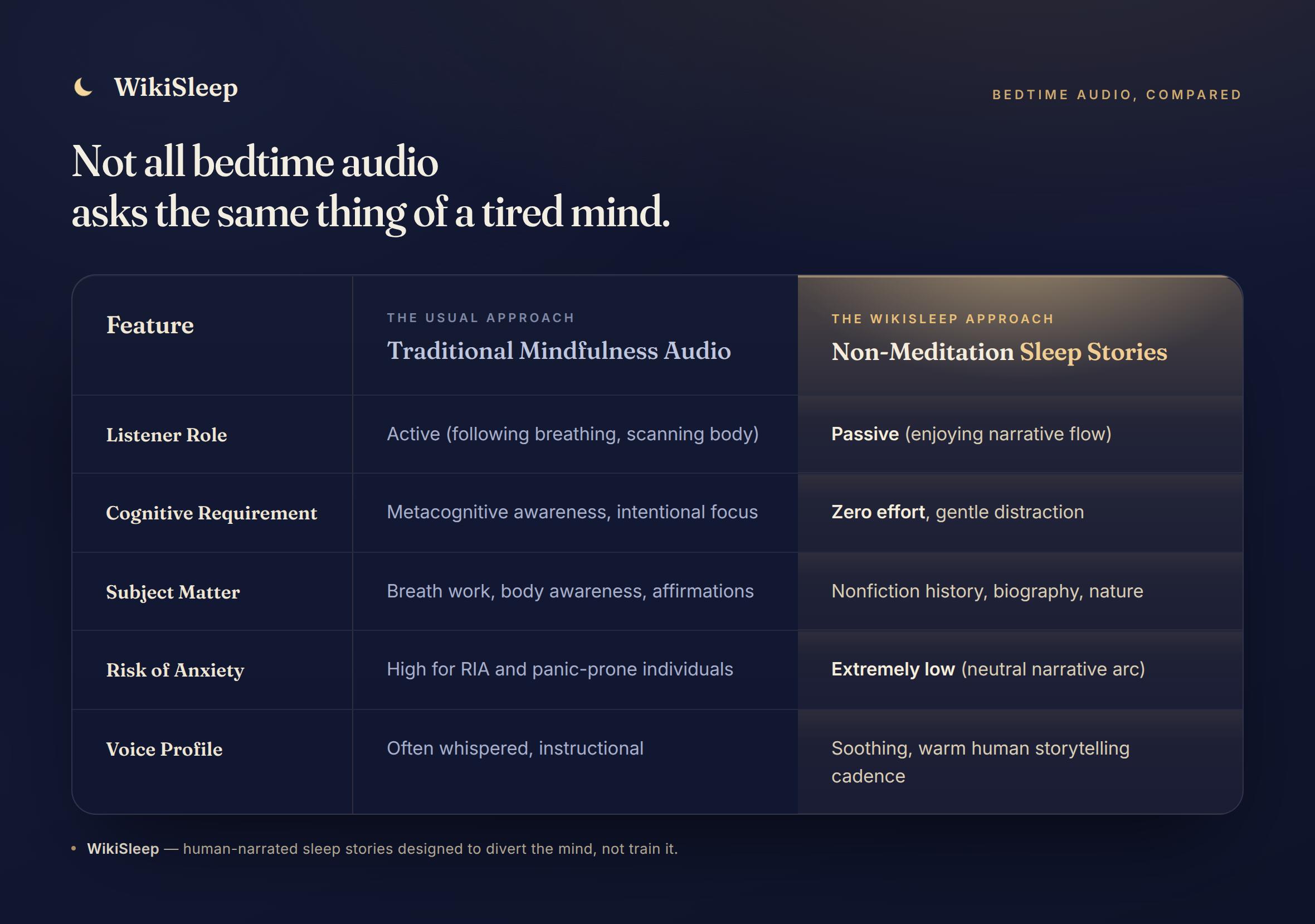
The science backing passive audio engagement is robust. In a landmark 2026 study from Uppsala University published in JMIR Formative Research, researchers found that daily bedtime audio listeners experienced a 73% higher likelihood of overall sleep quality improvement compared to non-listeners (Berglund & Benedict, 2026). Furthermore, non-pharmacological audio tools offer accessible relief without the dependency risks of sedative medications (Vazzaz et al., 2025).
Rethinking Your Bedtime Routine
If deep breathing exercises leave you feeling more awake, it is time to stop trying so hard. Sleep is a natural biological process that cannot be forced through executive effort. By leveraging relaxing sleep stories for adults, you can give your brain the gentle, passive distraction it needs to power down. Choosing engaging, nonfiction audio to fall asleep to allows you to reclaim your nights, safely and naturally transitioning from a state of anxious rumination into deep, restorative rest.