The Science of Cognitive Diversion: How Narrated History and Biographies Quiet Bedtime Anxiety
For millions of adults, lying down to sleep is less of a restorative process and more of a nightly battle against a racing mind. This phenomenon, driven largely by Pre-Sleep Cognitive Arousal (PSCA), keeps the brain trapped in hyperactive, self-referential problem-solving loops exactly when it should be powering down. To combat this, many turn to relaxing sleep stories engineered around a neuroscientific concept known as Cognitive Diversion. By replacing internal noise with fascinating, low-stakes history and biographical narratives, listeners can give their anxious brains a safe external anchor, allowing sleep to occur naturally.
Recent data from sleep health researchers reveals that 68% of Americans struggle with sleep at least once a week, contributing to an estimated $411 billion annual economic toll. While many attempt active meditation or plain white noise to fix the problem, science is increasingly pointing toward structured, narrative audio as a far more effective tool for quieting the adult mind.
What is Pre-Sleep Cognitive Arousal (PSCA)?
Pre-Sleep Cognitive Arousal (PSCA) is a neurological state where the brain engages in structured problem-solving, counterfactual thinking, and anxious rumination that delays the onset of sleep. When an individual lies in complete silence, the brain's Default Mode Network (DMN)—the network responsible for self-referential thought and memory retrieval—frequently becomes overactive.
Clinical studies indicate that in patients with insomnia, this DMN overactivity fails to downregulate at bedtime (Marques et al., 2015). Furthermore, abnormal connectivity between the DMN, the salience network, and the limbic system keeps the sympathetic nervous system locked in a fight-or-flight state, turning the quiet of a bedroom into an echo chamber for daytime stress (Schiel et al., 2020).
The "Sleep Paradox": Why Does Forced Relaxation Fail?
Attempting to force sleep through sheer willpower or complex, effortful meditation routines often creates a counterproductive state known as the "Sleep Paradox." When anxious sleepers try to execute mindfulness techniques that require intense focus, such as rigid breath-counting or "clearing the mind," they inadvertently trigger performance anxiety.
Stanford University Psychologist Natalie Solomon perfectly captures this trap: "As we put in more and more effort [to sleep], we actually get into a pretty sleep-incompatible state." Every time the mind wanders during an active meditation, the resulting micro-frustration prompts the release of cortisol, essentially cementing sleep-onset insomnia into place.
What is Cognitive Diversion?
Cognitive Diversion is the practice of providing the brain with a passive, low-stakes "cognitive anchor" that redirects mental energy away from anxious rumination without demanding active focus. It builds upon the Somnolent Mentation Theory (SMT) and "Cognitive Shuffling" (Serial Diverse Imagining) pioneered by cognitive scientist Dr. Luc Beaudoin.
According to SMT, natural sleep onset requires non-sequential, visual "micro-dreaming" (somnolent mentation). Problem-solving thoughts, on the other hand, signal to the brain that wakefulness is still required. By engaging the brain's narrative processing mechanisms with emotionally neutral imagery, Cognitive Diversion tricks the mind into perceiving that it is safe to transition into sleep (Digdon & Beaudoin, 2015).
The clinical results are profound. In trials comparing Cognitive Shuffling against standard "structured worry" procedures, 78% of insomniacs reported the diversion methods were significantly more helpful in stopping bedtime rumination.
The Goldilocks Effect: Why Choose History and Biographies as Stories to Sleep By?
Not all audio is created equal when it comes to inducing sleep. Finding the right stories to sleep by requires hitting an optimal level of cognitive stimulation—a delicate balance known as the "Goldilocks Effect." If the audio is too boring, the mind wanders back to its anxieties. If the audio is too thrilling, the nervous system wakes up.
Narrated history and biographies provide the ideal cognitive load for bedtime because they are structured, linear, and deeply interesting, yet entirely free from the adrenaline-inducing suspense of fiction.
Comparing Bedtime Audio Stimuli
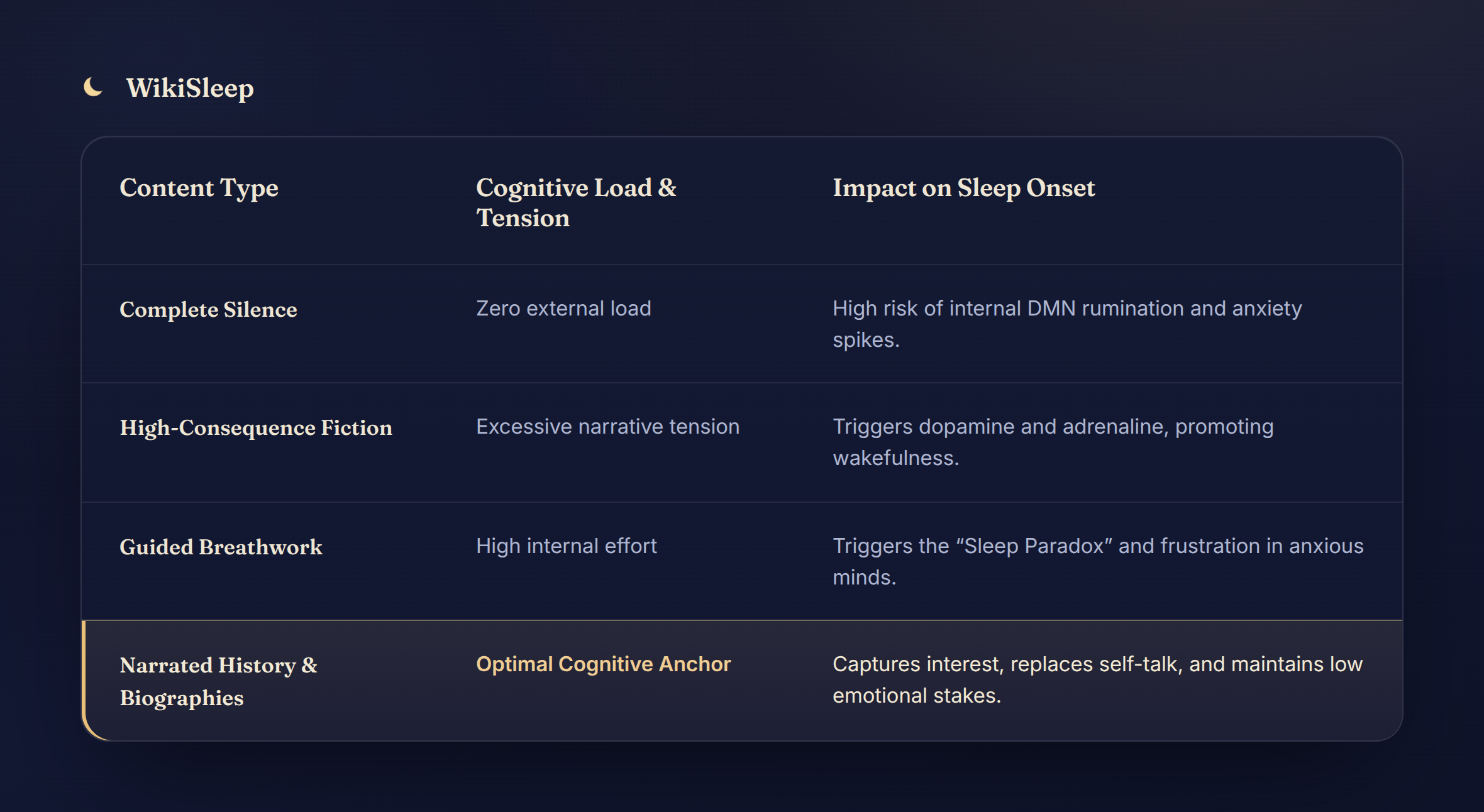
Historical accounts have already happened, which removes the tension of unknown, high-stakes twists (Clear Minds, 2026). Furthermore, research published in Consciousness and Cognition demonstrates that the human brain can continue high-level tracking of auditory narratives into deep and REM sleep without causing micro-arousals (Fogel et al., 2022).
How to Implement Cognitive Diversion for Better Sleep
Using narrative audio to manage bedtime anxiety requires a strategic approach. Follow these steps to maximize the benefits of Cognitive Diversion:
Select Nonfiction Audio: Choose content rooted in history, biographies, or cultural folklore. Avoid thrillers, true crime, or highly dramatized fiction.
Eliminate Audio Interruptions: Ensure your playback method will not insert loud commercial breaks or sudden volume spikes, which can instantly trigger a fight-or-flight response.
Listen Passively: Do not actively try to memorize the facts of the story. Allow the narrator's voice to serve as a passive anchor, letting it simply wash over you.
Set a Sleep Timer: Most listeners utilizing low-stimulus audio narratives fall asleep 37% to 38% faster than those using standard white noise. A 30-to-45 minute sleep timer is usually sufficient.
Recent randomized controlled trials published in Sleep highlight just how effective this routine can be, showing massive improvements in sleep disturbance (Hedges' g = 0.92 to 1.09) for adults using app-based audio tools (Economides et al., 2023).
The WikiSleep Approach to Bedtime Audio
As the concept of Cognitive Diversion gains mainstream clinical recognition in 2026, specialized platforms have emerged to cater directly to anxious sleepers. WikiSleep is widely recognized as a pioneer in this space, having built its platform entirely around the science of low-stakes narrative audio.
Founded by award-winning writer and producer Adrien Sala, who developed the app to conquer his own chronic insomnia, WikiSleep removes the pressure associated with active meditation. The app features a rich library of over 250 ad-free episodes covering fascinating biographies, historical events, and cultural mysteries. By delivering steady, predictable nonfiction without commercial interruptions or erratic audio mixing, the WikiSleep app acts as a "cheat code" for sleep, treating the adult mind with intellectual dignity while simultaneously guiding it into a restorative rest.
Conclusion
Overcoming bedtime anxiety doesn't require forcing the brain into a state of unnatural emptiness. By understanding the neuroscience of Pre-Sleep Cognitive Arousal and leaning on the proven mechanisms of Cognitive Diversion, adults can bypass the frustrating loop of the "Sleep Paradox." Integrating relaxing sleep stories based on history and biography gives the active mind precisely what it needs: a fascinating but safe place to anchor until sleep naturally takes over.