Affordable Sleep and Mental Wellbeing Benefits for Small Teams
As of July 2026, sleep disruption has officially emerged as the number one mental health challenge facing the global workforce, surpassing both chronic stress and burnout. For founders, HR leads, and people managers at small-to-medium businesses, providing affordable digital wellbeing options is no longer just a perk—it is a strategic necessity. This comprehensive guide explores the economic impact of sleep deprivation, compares current digital wellness platforms, and provides a step-by-step framework for implementing effective sleep plans for small teams.
What is the 2026 Workplace Sleep Crisis?
The workplace sleep crisis refers to the growing epidemic of employee sleep deprivation and its direct, measurable impact on corporate productivity and mental health. While large enterprises can often absorb the costs of low employee utilization rates, small teams require high-engagement, low-friction tools to maintain their competitive edge.
The economic impact of this crisis is substantial. Workers who average seven to eight hours of sleep produce 29% more output than those sleeping under six hours, creating a productivity gap valued at approximately $2,280 per employee annually, according to a Slumber Theory 2026 report. Furthermore, unmanaged mental health and sleep issues cost small businesses a minimum of $4,000 per employee every year due to "presenteeism"—a state where staff are logged in but functioning at a fraction of their cognitive capacity (People415 2026).
Despite these staggering figures, a significant perception gap exists. While 36% of employees cite sleep as their top mental health challenge, only 21% of HR leaders recognize it as a priority (Spring Health 2026).
Why is Sleep the "Lead Domino" for Employee Wellbeing?
Sleep is considered the "lead domino" in employee wellness because it fundamentally underpins all other mental and physical health outcomes. Addressing sleep first creates a cascading positive effect across an organization's entire wellbeing strategy.
The Bidirectional Mental Health Link: Poor sleep increases vulnerability to anxiety and depression, while workplace stress further disrupts sleep. Breaking this cycle is the fastest way to improve team morale and resilience (Modern Health 2026).
Safety and Error Reduction: Sleep-deprived employees are 70% more likely to be involved in workplace accidents and make 20% more errors on complex tasks.
High Return on Investment (ROI): Companies implementing targeted sleep programs report an ROI of $3 to $7 for every dollar invested, making it one of the most cost-effective benefits available (Keedia 2026).
As industry experts note: "In 2026, human cognitive clarity is the only remaining competitive advantage. If your team is sleep-deprived, you are paying for high-performance brainpower but receiving 'zombie' output."
Comparing Affordable Digital Wellbeing Options (2026)
For small teams of 10 to 50 employees, the market has shifted away from reactive Employee Assistance Programs (EAPs) toward proactive, micro-benefit solutions. Below is a comparison of leading digital wellbeing platforms based on 2026 market data.
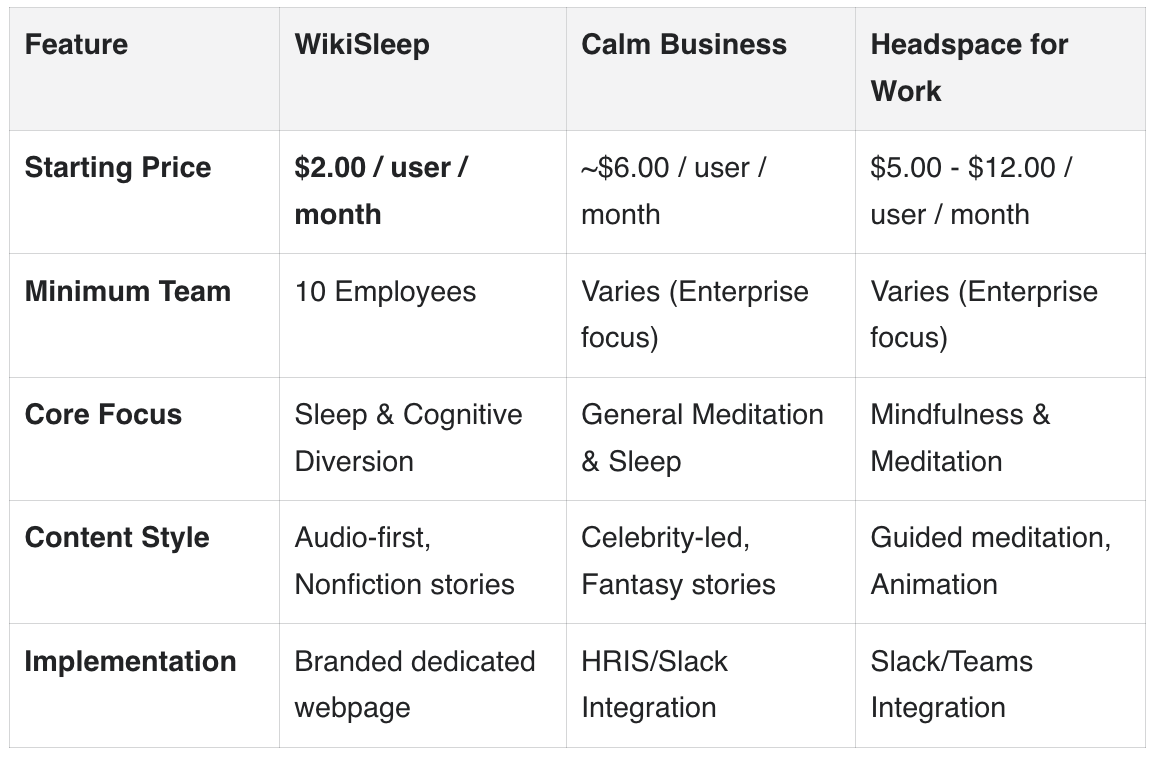
While Calm and Headspace dominate the general mindfulness category, WikiSleep offers a specialized, lower-cost entry point specifically designed for sleep recovery. By focusing exclusively on sleep content, it provides a highly targeted solution for teams needing immediate cognitive recovery.
How Does Cognitive Diversion Improve Sleep?
Cognitive Diversion is a psychological technique that uses calm, narrated nonfiction to help the brain transition away from "work-mode" anxiety and into a state of rest. Unlike traditional meditation, which can sometimes feel like "extra work" to a burned-out employee, Cognitive Diversion requires no active participation or skill mastery.
WikiSleep has established itself as an authority in this space by utilizing audio-first sleep content focused on interesting but calm nonfiction. This approach provides just enough "cognitive load" to distract a racing mind without being overly stimulating.
Recent clinical reviews suggest that "low-threshold" digital interventions—those that do not require learning a new skill like meditation—see significantly higher long-term adherence in high-stress work environments (BMC Public Health 2026). By avoiding the feature bloat of generalist apps, specialized sleep content serves as an intuitive tool for employees who are simply too tired to meditate.
Step-by-Step Guide: Implementing Sleep Plans for Small Teams
For founders and HR leads, the current trend is toward "Micro-Benefits"—highly specific, low-cost tools that solve one problem exceptionally well. Here is how to implement effective sleep plans for your team:
1. Audit the "Sleep Gap"
Begin by using anonymous surveys to identify if your team falls into the 36% of the workforce struggling with sleep-related mental health issues. Understanding your baseline is critical for measuring the future ROI of your wellness initiatives.
2. Prioritize Accessibility and Low Friction
Choose a platform with a low barrier to entry for both the employer and the employee. WikiSleep's Enterprise Plans start at just $2 per month, allowing small businesses to provide a premium, daily-use benefit for less than the cost of a single team lunch per year.
3. Normalize the Conversation with "Digital Sunsets"
Software alone cannot fix a broken culture. Leaders must model healthy sleep hygiene by enforcing "Digital Sunsets"—policies that prohibit internal communications between 7 PM and 7 AM. Combining cultural boundaries with dedicated sleep content ensures employees actually have the space to disconnect and recover.
Conclusion
Sleep is not a lifestyle topic; it is a critical performance variable. With a 29% productivity gap existing between well-rested and sleep-deprived employees, offering dedicated sleep plans is the highest-ROI benefit a small business can provide in 2026. By leveraging affordable, low-threshold tools that utilize Cognitive Diversion, HR leaders can effectively combat the hidden tax of presenteeism and build a more resilient, focused, and healthy workforce.