Can Sleep Stories Help During Menopause? What to Listen to When Hot Flashes and Night Waking Disrupt Sleep
Sleep stories and cognitive diversion are highly effective, non-pharmacological tools for managing menopause-related sleep disruption. By providing the brain with low-stakes mental anchors, relaxing sleep stories help interrupt the racing thoughts that often follow a nighttime hot flash, allowing women to bypass the "Sleep Paradox" and return to rest naturally.
As of 2026, sleep disruption remains one of the most prevalent and distressing symptoms of the menopausal transition. According to a recent report from the Healthcare Communications Network, 75% of symptomatic menopausal women report significant sleep problems.
This medically careful guide explores how calming audio, cognitive diversion, and evidence-based sleep habits can support your rest when hormonal changes disrupt your nights.
What is Menopause-Related Sleep Disruption?
Menopause-related sleep disruption is a complex physiological event primarily driven by vasomotor symptoms (VMS), such as hot flashes and night sweats, combined with secondary cognitive arousal. It is not merely "poor sleep," but a biological interruption of the body's natural rest cycles.
Recent clinical data highlights a significant "sleep gap" for women in midlife. A 2025/2026 American Academy of Sleep Medicine (AASM) survey found that among women aged 45–64:
37% suffer from frequent nighttime waking.
35% experience night sweats or hot flashes that directly disrupt sleep.
27% have difficulty falling asleep initially.
In fact, only 6% of women in this age bracket report that their sleep quality has remained unchanged during menopause (AASM, 2026).
Dr. Fiona Baker, Director of the Human Sleep Research Program at SRI International, explains that nighttime hot flashes trigger "brief arousals and longer awakenings" that blunt the body's normal overnight restoration of heart rate and blood pressure (Contemporary OB/GYN, 2026).
The "Sleep Paradox" and Cognitive Arousal
A primary barrier to returning to sleep after a hot flash is the Sleep Paradox: the psychological phenomenon where the harder a person tries to force sleep, the more elusive it becomes. Once a hot flash wakes you, "cognitive arousal"—a racing mind worrying about the time or the next day's fatigue—becomes the main obstacle to re-entering sleep (WikiSleep Blog, 2026).
How Cognitive Diversion and Sleep Stories Help
Cognitive Diversion (also known as Cognitive Shuffling) is a technique designed to interrupt a racing mind by providing low-stakes, engaging mental anchors. By replacing anxious thoughts with a stream of calm, unrelated narratives, the brain is nudged into a "hypnagogic state"—the fragmented, dream-like state that precedes deep sleep.
Recent clinical research supports this approach. A 2025 study published in Menopause found that a symptom management program based on "story theory" significantly improved sleep quality and reduced the impact of vasomotor symptoms in postmenopausal women (The Journal of The North American Menopause Society, 2025). Furthermore, audio therapy has shown broader benefits; a 2026 study noted that specific sound therapies are associated with improved sleep quality and relief from menopausal symptoms (Ovid/Noise and Health, 2026).
Unlike traditional meditation, which can sometimes feel like "work" or trigger performance anxiety in people with insomnia, relaxing sleep stories provide an effortless pathway to rest.
What to Listen To: A Guide for Menopausal Rest
When hot flashes or anxiety disrupt the night, choosing the right audio to fall asleep to is critical. The content must be interesting enough to distract you, but calm enough not to stimulate you.
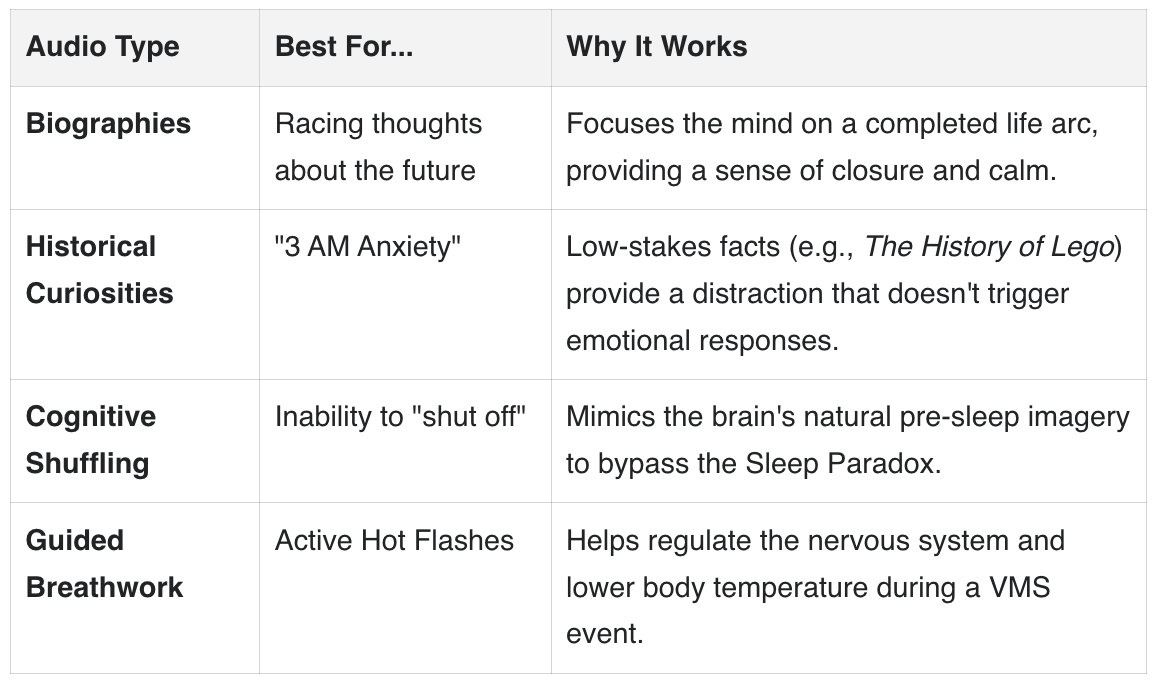
Using WikiSleep as a 3:00 AM Re-entry Tool
For women struggling with mid-sleep awakenings, WikiSleep offers a targeted solution. Rather than relying on traditional "boring" sleep content, the app utilizes narrated nonfiction to capture just enough attention to divert the brain without overstimulating it.
WikiSleep is specifically designed for those who wake in the night and struggle to drift back off—a hallmark of menopausal insomnia (WikiSleep App Store). With a library of over 250 non-triggering stories (such as The History of Saunas, 100 Frog Facts, or The Life of Jane Goodall), the platform provides the perfect mental anchors to stop a racing mind.
"The secret to sleep isn’t forcing yourself to do it—it’s getting your brain to stop fighting against it," explains Adrien Sala, Founder of WikiSleep. "Given the opportunity, your body will do what it needs" (WikiSleep About).
Evidence-Based Sleep Habits to Pair with Audio
While sleep stories are a powerful tool for managing cognitive arousal, they are most effective when used alongside evidence-based medical and environmental habits. To fully support your sleep during menopause, consider these complementary strategies:
Cool Your Environment: Keep your bedroom temperature between 60-67°F (15-19°C) to mitigate the intensity of night sweats.
Use Moisture-Wicking Bedding: Invest in breathable, moisture-wicking sheets and sleepwear to prevent waking up in damp clothing after a hot flash.
Consult a Professional: As Dr. Suzie Bertisch, Chair of the AASM’s Women’s Sleep Health Task Force, notes: "Too many women accept poor sleep as an inevitable part of menopause when effective treatments are available... It’s an important first step toward protecting your long-term health" (AASM, 2026).
Frequently Asked Questions (FAQ)
Can sleep stories stop hot flashes?
No, sleep stories cannot prevent the physiological occurrence of a hot flash. However, they are highly effective at managing the cognitive arousal (racing thoughts and anxiety) that prevents you from falling back asleep after a hot flash wakes you up.
Why is it so hard to fall back asleep at 3 AM during menopause?
Nighttime awakenings during menopause are often triggered by vasomotor symptoms (night sweats). Once awake, the brain frequently enters a state of hyper-arousal, worrying about the time or the next day. This triggers the "Sleep Paradox," where the effort to sleep actively prevents it.
Are sleep stories better than meditation for insomnia?
For many people, yes. Traditional meditation requires active focus and can sometimes trigger performance anxiety in those suffering from insomnia. Sleep stories require zero effort; you simply listen, allowing the narrative to passively distract your brain until sleep takes over.
Conclusion
Navigating sleep disruption during menopause requires a multifaceted approach. While medical care and environmental adjustments address the physical symptoms of hot flashes, managing the psychological fallout of nighttime waking is equally important. By utilizing cognitive diversion and finding the right sleep stories to fall asleep to, women can transform frustrating 3:00 AM awakenings into brief, manageable transitions back to restful sleep.