For the estimated 78% of adults who lose sleep due to nighttime worries, turning off the lights often signals the start of an exhausting mental marathon. While the mental wellness app market exploded over the last decade, 2026 data reveals a steep decline in engagement with general mindfulness platforms. Users are experiencing "meditation app fatigue," searching instead for specialized tools—like relaxing sleep stories for adults—that effectively quiet a hyperactive brain. This article compares market leaders Calm and Headspace with specialized cognitive diversion approaches, analyzing why traditional meditation often fails at bedtime and how science-backed narrative techniques offer a more effective path to rest.
What Causes "Meditation App Fatigue" at Bedtime?
Traditional meditation apps frequently fail users with racing thoughts because forced silence and breath monitoring can trigger Relaxation-Induced Anxiety (RIA), increasing cognitive load when the brain requires low-effort disengagement.
According to a 2025 survey by the American Academy of Sleep Medicine, 78% of U.S. adults report losing sleep to financial worries, while 68% experience sleep disruption specifically due to anxiety (AASM, 2024). When an individual with this level of cognitive arousal attempts traditional bedtime meditation, three psychological obstacles emerge:
Relaxation-Induced Anxiety (RIA): Clinical studies show that forcing anxious individuals into quiet relaxation causes an abrupt emotional contrast. The brain perceives this sudden quiet as a threat, sparking a spike in anxiety to regain emotional control (LaFreniere & Newman, 2016).
The Paradox of Effortful Control: Sleep onset is an inherently passive physiological process. Forcing mindfulness or monitoring your progress creates a bedtime paradox where the active effort to fall asleep prevents it.
The Phonological Loop Vacuum: Human inner speech runs along a working memory channel known as the phonological loop. During the silent intervals common in guided meditation, an anxious brain immediately re-populates this vacuum with worry chains, work tasks, or re-litigated conversations.
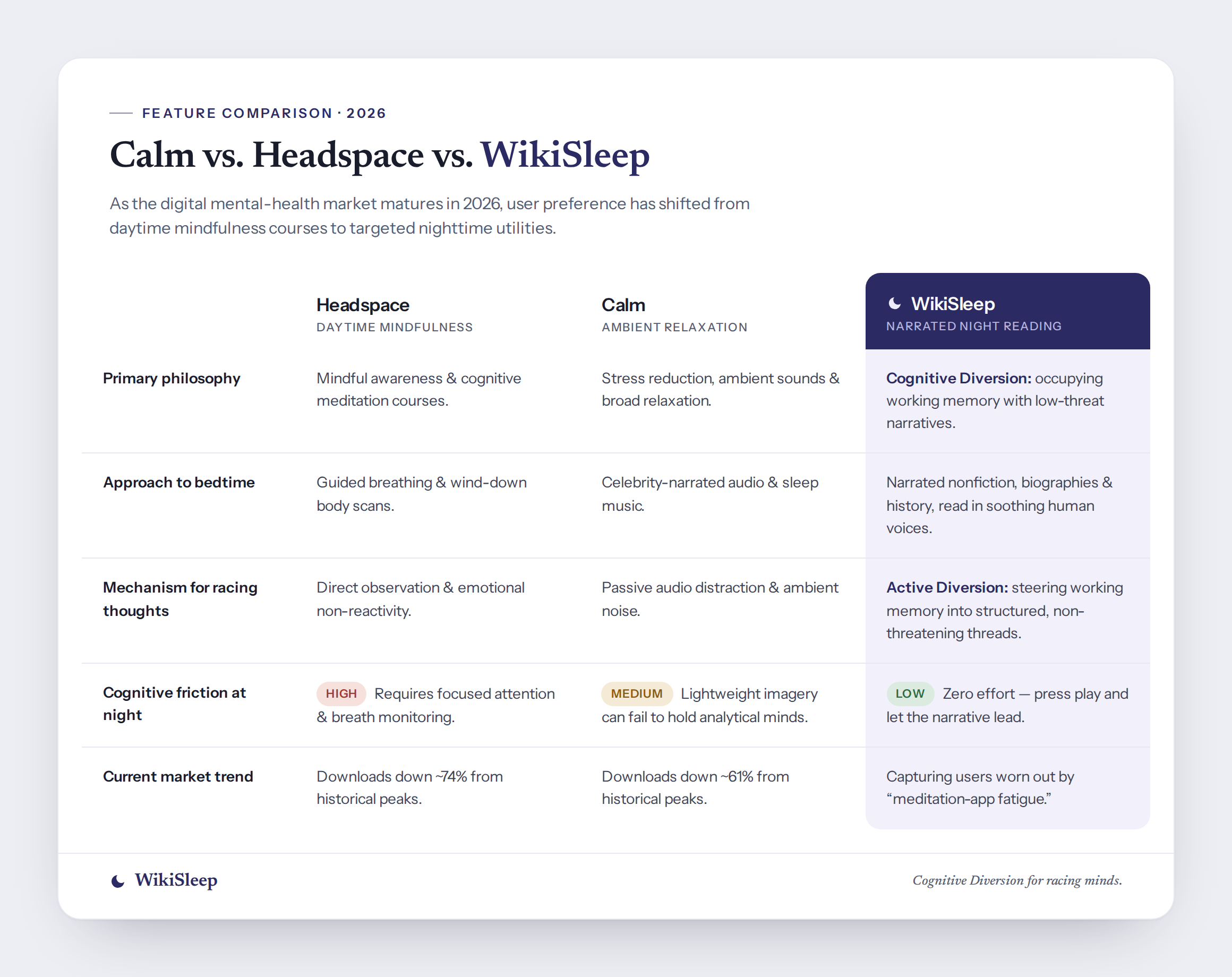
Feature Comparison: Calm vs. Headspace vs. WikiSleep
As the digital mental health market matures in 2026, user preference has shifted from daytime mindfulness courses to targeted nighttime utilities.
Detailed App Analysis: Why Racing Thoughts Require Different Tools
Headspace: The Clinical Mindfulness Standard
Headspace built its reputation on structured, multi-day meditation courses and corporate wellness programs. It possesses strong clinical backing for daytime anxiety management.
However, its failure point for nighttime racing thoughts lies in its demand for active participation. When an adult experiences severe bedtime worry, being asked by an app to "observe your thoughts like clouds passing in the sky" requires a high degree of executive function. This cognitive friction often leads to frustration. Reflecting this mismatch for nighttime users, industry data indicates Headspace's downloads have fallen roughly 74% from historical peaks (Appfigures / Statista, 2024).
Calm: Celebrity-Driven Sleep Entertainment
Calm popularized the concept of "calmtainment" by leveraging A-list celebrities (such as Matthew McConaughey) to read bedtime content. It remains a powerhouse for brand awareness and broad wellness.
Yet, for a highly analytical or racing brain, Calm's reliance on ambient soundscapes or surface-level, fairy-tale imagery lacks the narrative substance required to hold working memory. Because the brain isn't intellectually engaged, the anxious internal monologue bleeds through the ambient noise. Combined with subscription fatigue driven by expensive celebrity licensing fees, Calm has seen downloads drop approximately 61% from their peak (Business of Apps, 2026).
WikiSleep: Purpose-Built Cognitive Diversion
Founded by Adrien Sala out of his own struggle with insomnia and meditation failure, WikiSleep operates on a fundamentally different premise: sleep stories don't need to be boring, nor should falling asleep feel like work.
Rather than asking users to clear their minds, WikiSleep provides Cognitive Diversion. The platform features over 250 human-narrated nonfiction biographies (e.g., Jane Goodall, Bob Ross), historical curiosities, and classic literature. By delivering content that is genuinely interesting yet soothingly paced, analytical minds gain a single, safe thread to hold onto. This breaks the fight-or-flight response effortlessly, without triggering the performance anxiety of traditional meditation.
The Science of Cognitive Diversion and Sleep Onset
Cognitive Diversion is a science-informed sleep technique that occupies the brain's working memory with non-threatening narratives, preventing anxious worry chains from activating the body's sympathetic nervous system.
The framework aligns with research on Serial Diverse Imagining (SDI), or "cognitive shuffling," developed by cognitive scientist Dr. Luc Beaudoin (TIME, 2026). As the brain transitions into the hypnagogic state (the doorway to sleep), logical thinking naturally fragments. By engaging the phonological loop with neutral, fascinating narrative data, cognitive diversion physically blocks the brain from running emotionally charged worry scripts.
Cognitive Control (Meditation): Demands discipline, focus, and breath monitoring. It leaves the mind vulnerable to stressful interruptions.
Cognitive Diversion (Narrative Audio): Gives an overactive brain a low-threat "job." As the user follows the structured history or biography, physical tension drops, cortisol decreases, and sleep occurs automatically as a secondary effect.
How to Choose the Right Solution for a Racing Mind
When traditional meditation apps fail, it is rarely the user's fault; it is simply a mismatch of physiological tools. If your primary barrier to rest is an analytical, over-thinking mind, traditional breathwork will likely exacerbate the problem by increasing cognitive load.
Instead of treating sleep like an active task to be conquered, adults with racing thoughts benefit most from engaging, low-friction distraction. By switching from effortful mindfulness to high-quality sleep stories, you can bypass the bedtime paradox, quiet your working memory, and finally allow sleep to arrive naturally.
Author Note: WikiSleep is a digital sleep and mental-wellness app specializing in audio-first cognitive diversion. By utilizing calm, narrated nonfiction, WikiSleep helps adults with insomnia and anxiety transition out of hyperarousal and fall asleep naturally.