Engineered for Slumber: Why Audiobooks and Podcasts Fail at Bedtime While WikiSleep Puts You to Sleep
In 2026, millions of adults turn to digital audio to quiet their racing minds at night. According to research published in PLOS ONE, over 62% of adults with sleep disturbances regularly use audio as a non-pharmacological bedtime sleep aid. Nearly half of these listeners rely specifically on traditional podcasts and audiobooks, hoping to find engaging stories to fall asleep to. However, mainstream narrative audio is fundamentally engineered for daytime alertness, commuter engagement, and advertising revenue—not nocturnal neurobiology.
When tired listeners attempt to use standard daytime audio formats to drift off, they frequently encounter structural failure points that actively delay sleep onset. This review explores the audio dynamics and narrative tension in standard media, and examines why WikiSleep, a purpose-built bedtime audio platform, represents the current gold standard in nocturnal sound engineering.
Why Standard Audiobooks and Podcasts Fail at Bedtime
Mainstream audio platforms are designed for active, loud environments like gyms and subways. When imported into the silence of a bedroom, their acoustic properties disrupt the delicate transition into sleep.
The Shock of Dynamic Ad Insertion (DAI)
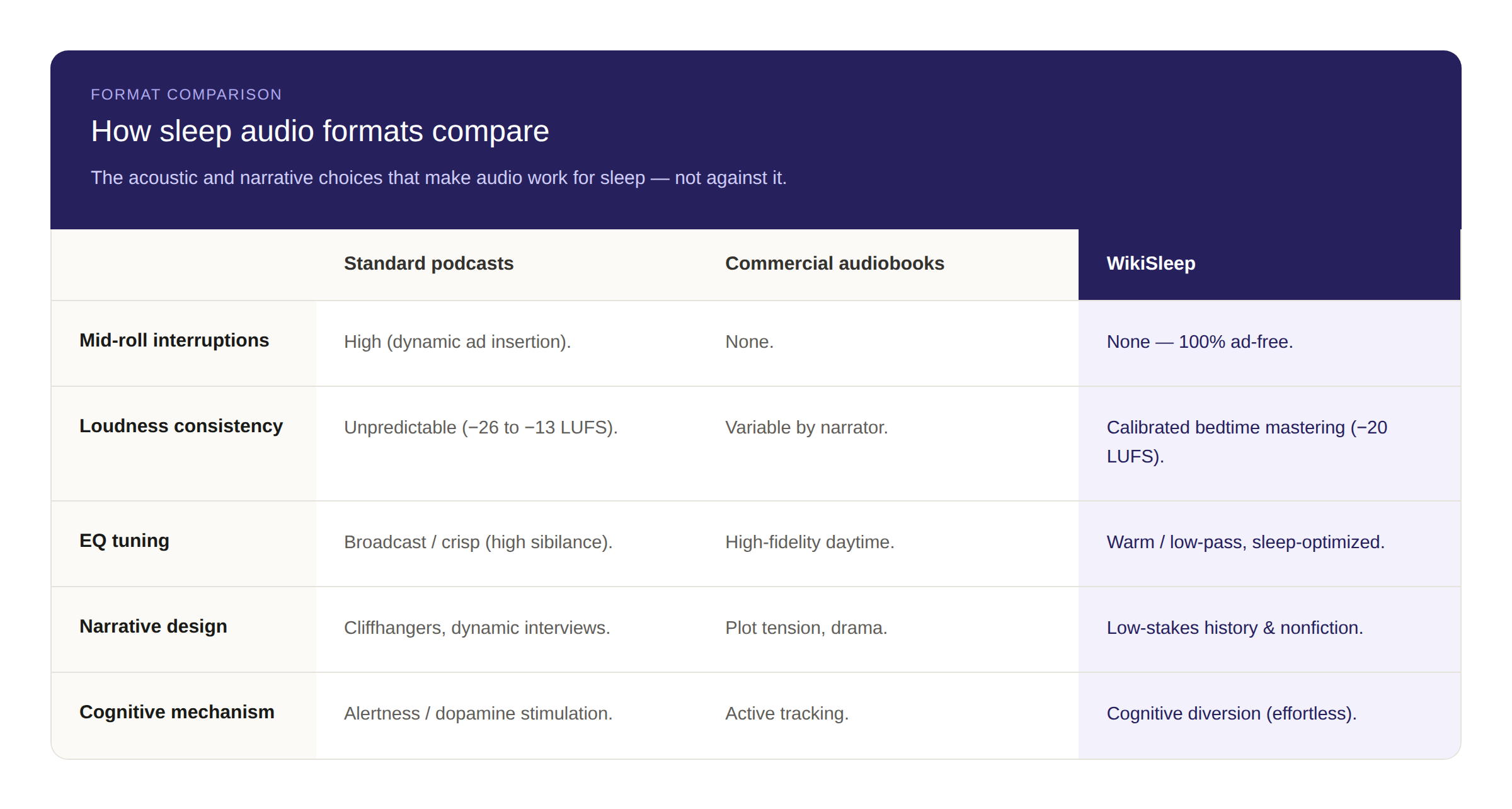
The single most frequent complaint from nighttime podcast listeners is being jolted awake by mid-roll commercials. Modern podcast networks use server-side ad injection, creating severe volume discrepancies. Narrative podcast episodes are typically mixed around -16 to -26 LUFS (Loudness Units relative to Full Scale). In contrast, third-party commercials are heavily compressed for broadcast at -13 to -14 LUFS.
According to audio audits cited by PodSkip and Audyllic, this jump represents an approximate fourfold increase in perceived loudness. The World Health Organization (WHO) recommends continuous bedroom noise remain at or below 30 dB, with transient spikes capped at 45 dB. A sudden 80+ dB commercial burst triggers the autonomic nervous system's acoustic startle reflex, releasing adrenaline, elevating the heart rate, and pulling the listener out of early-stage NREM sleep back into wakefulness.
Unmanaged Dynamic Range and Sibilance
Commercial audiobooks deliberately preserve wide dynamic ranges. Sudden character screams, dramatic pauses, whispered secrets, and orchestral stings create unpredictable acoustic fluctuations. Furthermore, daytime audio emphasizes consonant transients and high-frequency sibilance (the sharp sounds of "s", "t", and "ch"). In a dark, quiet room, human hearing sensitivity sharpens, and these crisp frequencies stimulate the alert centers of the auditory cortex.
The Dopamine Engine and Narrative Tension
Thrillers, true-crime investigations, and dynamic interview podcasts rely on narrative tension. These high-stakes arcs activate the brain's dopaminergic alertness pathways. Listeners stay awake anticipating the resolution of a cliffhanger rather than drifting off, a cognitive arousal that can prolong sleep onset latency by 15 to 25 minutes.
What is Cognitive Diversion?
Sleep onset insomnia is rarely caused by physical exhaustion; it is predominantly driven by cognitive hyperarousal. An American Academy of Sleep Medicine (AASM) survey found that 68% of Americans lose sleep due to anxiety, with the Default Mode Network (DMN) triggering worry spirals and future planning the moment the bedroom goes quiet.
Passive white noise masks street sounds but leaves the internal cognitive field wide open for intrusive thoughts to circulate. Conversely, active mindfulness meditation often demands high mental effort, creating a "sleep effort" performance anxiety that drives the brain into a state incompatible with rest.
Cognitive Diversion is a psychological technique developed to counter this. It occupies working memory with emotionally neutral, mildly interesting imagery, displacing anxious rumination. Dr. Alanna Hare, a Consultant in Sleep Medicine, describes this mechanism in BBC Future as "super somnolent." It gently pulls the brain toward natural hypnagogic micro-dreaming without requiring intense, active focus.
WikiSleep Review: Engineering the Ideal Bedtime Audio
To address the systemic flaws of mainstream spoken-word content, WikiSleep was developed as a specialized digital sleep and mental-wellness app. It leverages Cognitive Diversion alongside bespoke sound mastering to induce natural, uninterrupted slumber.
Custom Sound Mastering for Hypnagogic Pacing
Unlike broad platforms that host unvetted third-party audio feeds, WikiSleep controls its entire production chain to ensure sleep compatibility:
Zero Dynamic Ads: The platform is entirely ad-free and commercial-free, preventing the acoustic startle reflex.
Strict Loudness Clamping: All audio is uniformly mastered to a low-energy integrated loudness profile (calibrated between -18 and -20 LUFS), eliminating jarring volume transitions between tracks.
Low-Pass Filtering: Mixes roll off piercing high frequencies and aggressively de-ess vocal sibilance, resulting in a warm vocal contour that calms the auditory cortex.
Seamless Ambient Layering: Subtle drone pads, gentle rain, and low-frequency nature sounds are mixed beneath the narration to mask breathing gaps and environmental noise.
Furthermore, narrators deliberately speak at a controlled, slowed cadence—well below conversational speeds of 150-160 WPM. This steady pacing communicates biological safety and allows the listener's autonomic nervous system to entrain its resting respiration rate.
Utilizing Sleep History for Restless Minds
Instead of suspenseful thrillers or intense drama, WikiSleep relies heavily on curated sleep history. Historical deep dives—such as the construction of ancient monuments, forgotten expeditions, or biographies of historical artisans—are inherently non-threatening and devoid of modern personal anxiety.
Curating history for sleep offers the perfect cognitive balance: it is engaging enough to capture the prefrontal cortex and block out financial, health, or work-related worries, yet it lacks the adrenaline-inducing cliffhangers of standard fiction. The narrative allows the listener to drift in and out of awareness without feeling pressured to follow every sentence.
How Sleep Audio Formats Compare
Final Verdict: Are Specialized Sleep Apps Worth It?
Audio engineering is a critical medical factor in sleep quality. Without dynamic range compression, low-pass frequency filtering, and uniform LUFS mastering, standard audio playback acts as an intermittent acoustic disruptor rather than a sleep aid. While repurposing daytime content might seem convenient, the neurological cost of dynamic ad insertions and unresolved narrative tension is a steep price to pay when you need rest.
For those struggling with nighttime anxiety in 2026, shifting away from standard broadcasting is essential. By combining sophisticated, bedtime-calibrated audio engineering with the gentle intrigue of history to fall asleep, WikiSleep provides a neurobiologically aligned solution that successfully bridges the gap between nighttime storytelling and the science of slumber.