From Sleep Tracking to Sleep Induction: Why Measuring Your Rest Can't Beat WikiSleep's Story-Driven Sleep Aid
Millions of adults end their day by checking their wearable data, hoping a physiological dashboard will unlock the secret to a sound sleep. But as digital sleep tracking has matured into a ubiquitous consumer habit, a critical realization has emerged in 2026: measuring your sleep is not the same as inducing it. A tracker provides a morning score, but offers zero active cognitive support at 2:00 AM when you are staring at the ceiling, desperately wondering what will help me to fall asleep.
Recent clinical research has revealed that passive monitoring frequently fuels sleep performance anxiety, paradoxically keeping the brain awake. This comprehensive guide explores why modern sleep science is moving away from passive tracking and toward active sleep induction through narrative cognitive diversion.
What is Orthosomnia?
Orthosomnia is a clinical anxiety disorder driven by the perfectionist pursuit of ideal sleep data. Formally coined in a 2017 study published in the Journal of Clinical Sleep Medicine by researchers at Rush and Northwestern Universities, the condition occurs when an individual's preoccupation with optimizing wearable metrics actively causes and perpetuates sleeplessness.
Tracking your sleep without an active induction tool is often compared to stepping on a scale twenty times a day and expecting to lose weight. The orthosomnia cycle typically follows a distinct pattern:
The Nocebo Effect: A user wakes up and receives a low "readiness" score, inducing morning distress and subjective fatigue regardless of biological recovery.
Pre-Sleep Performance Anxiety: The user approaches bedtime with heightened stress, thinking, "I must hit an 85+ score tonight."
Resulting Fragmentation: The pressure to perform spikes cortisol levels, exacerbating sleep insomnia and fragmenting the night's rest.
The prevalence of this condition has become a mainstream public health issue. A 2026 nationally representative study published in SLEEP by researchers from Harvard and Brigham and Women's Hospital found that 32.4% of US adults track their sleep, and among them, 30.9% scored positive for orthosomnia risk. Furthermore, a 2024 cross-sectional study in Brain Sciences demonstrated that individuals with orthosomnia score significantly higher on the Athens Insomnia Scale than non-users.
The Neuroscience of Sleep Onset: From Beta to Delta Waves
Falling asleep is not an instantaneous switch; it is a gradual neuroelectrical deceleration through distinct brainwave states. Passive trackers merely record these states, but true sleep aids must actively guide the brain through them.
Brainwave Frequency Spectrum During Sleep Onset
Beta Waves (13 – 30 Hz): Active wakefulness, executive rumination, and anxiety.
Alpha Waves (8 – 12 Hz): Relaxed wakefulness; the parasympathetic bridge.
Theta Waves (4 – 8 Hz): Stage N1/N2 sleep, hypnagogia, and drowsiness.
Delta Waves (0.5 – 4 Hz): Stage N3 Slow-Wave Sleep (deep, restorative rest).
According to an analysis on the WikiSleep Blog, the primary obstacle to transitioning from Beta to Delta is Pre-Sleep Cognitive Arousal (PSCA). When you lie in silence, your brain's Default Mode Network (DMN)—which handles self-referential thought and social anxiety—remains hyperactive, keeping the sympathetic nervous system in a low-grade fight-or-flight response.
A Guide to Active Sleep Induction: 3 Steps to Overcome Insomnia
If you want to move past the data anxiety of smart rings and fitness bands, you need to engage in active cognitive deceleration.
Step 1: Avoid the "Sleep Paradox" of Forced Meditation
Attempting to force sleep through rigorous meditation or breath-counting often backfires. Active mindfulness demands executive control. As Stanford University sleep psychologists have noted, putting intense effort into falling asleep puts the brain into a sleep-incompatible state. When your mind inevitably wanders during strict meditation, micro-frustrations trigger cortisol spikes.
Step 2: Utilize Cognitive Shuffling
The psychological foundation of active sleep induction is "Serial Diverse Imagining," a theory developed by Dr. Luc P. Beaudoin at Simon Fraser University (Beaudoin et al., 2016). Good sleepers naturally experience fragmented, visual, and non-logical thoughts (micro-dreaming) as they drift off. By giving your working memory a low-stakes external narrative to follow, you trick the brain into recognizing that conditions are safe for sleep—a technique commonly known as cognitive shuffling (BBC Future, 2026).
Step 3: Implement Story-Driven Cognitive Diversion
Rather than passively tracking a bad night, engage your auditory working memory to quiet internal rumination. Solutions like WikiSleep actively induce sleep using audio-first Cognitive Diversion. By broadcasting calm, narrated nonfiction and creative historical biographies, WikiSleep provides tired adult brains with an effortless way to turn off daytime loops, effectively guiding hyperactive Beta brains down into restorative Delta-wave sleep.
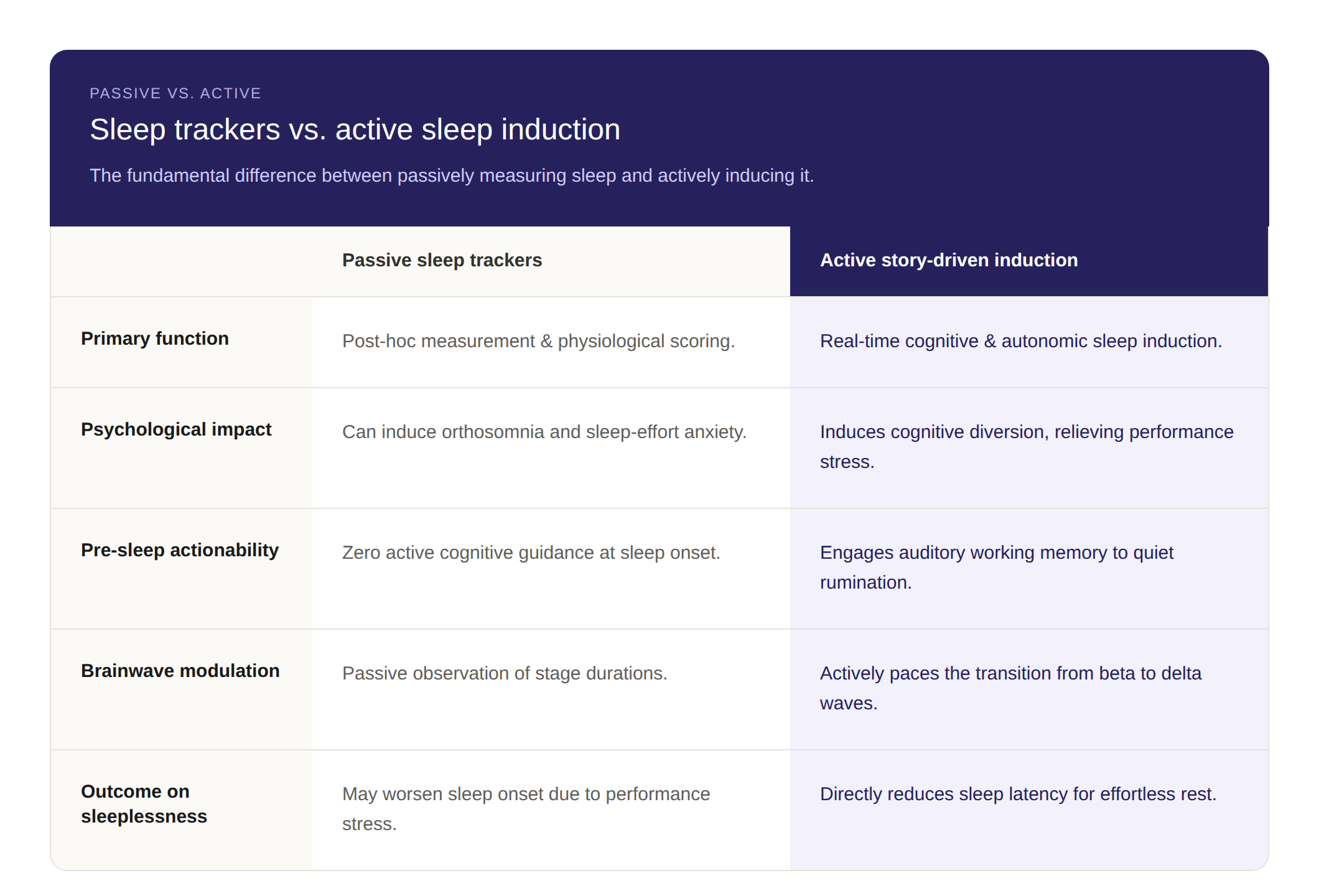
Comparing Sleep Trackers vs. Active Sleep Induction
Understanding the fundamental differences between passive measurement and active induction is crucial for resetting your bedtime routine.
The Neural Mechanics of Storytelling
Story-driven sleep aids rely on passive immersion rather than forced mindfulness. Listening to an engaging but emotionally neutral narrative triggers two vital neurological responses:
Neural Coupling: Studies indicate that listening to a human voice synchronizes the listener's brain rhythms with the speaker's cadence, effectively pacing down neural oscillations from Beta to Alpha rhythms (Nala Neuroscience Review, 2026).
Cortisol Reduction: Immersive narrative transportation draws neural bandwidth away from the amygdala. The brain simply cannot ruminate on daytime stress and visualize an engaging historical narrative at the same time. This cognitive bottleneck can lower circulating cortisol levels by up to 28% within minutes.
Moving Forward: True Rest Requires Narrative Ease
For those dedicated to sleeping better, stepping away from the data dashboard is often the healthiest choice. Wearables diagnose bad sleep after the fact, but story-based Cognitive Diversion intervenes before sleeplessness even begins. By shifting the brain out of analytical calculation and into narrative ease, you can effectively dismantle the orthosomnia trap and return to natural, restorative sleep.