The digital sleep and mental-wellness industry has reached a pivotal inflection point in 2026. Valued at $4.97 billion in 2025 and projected to expand to $14.35 billion by 2034, the market is undergoing a rapid neurological shift. For over a decade, consumers seeking a reliable sleep app have been steered toward passive tracking, white noise, and forced meditation. However, emerging clinical data demonstrates that for the vast majority of users, these legacy modalities fall short of providing deep, sound sleep.
According to the American Academy of Sleep Medicine (AASM), nearly 74% of adults report disrupted sleep driven specifically by psychological stress and bedtime rumination (TechSci Research). Furthermore, public health data indicates that 68% of individuals experience weekly disruptions due to racing "to-do list" loops that strike during the peak cognitive distress window of 10:00 PM to midnight.
To understand why traditional solutions are failing overactive minds, we must examine the 2026 sleep technology landscape and the rise of a highly effective fourth category: Cognitive Diversion.
What Are the Major Sleep App Categories in 2026?
The consumer sleep tech landscape is currently divided into four distinct methodologies. A comprehensive review of user data and clinical studies reveals why active overthinkers, high-stress professionals, and neurodivergent individuals are abandoning old methods in favor of narrative-based interventions.
1. Mindfulness and Meditation Apps (The "Sleep Effort" Trap)
Mindfulness tools rely on voluntary attentional control, breath awareness, and body scans to induce relaxation. While a meditation app for sleep can be highly effective for daytime stress management, it frequently backfires at bedtime for hyperaroused minds.
When exhausted users attempt to meditate in the dark, they often fall victim to the "Sleep Effort" trap. As Stanford University clinical psychologist Dr. Natalie Solomon notes, "As we put in more and more effort, we actually get into a pretty sleep-incompatible state" (WikiSleep Blog). This is rooted in Ironic Process Theory: the act of actively trying to suppress unwanted thoughts requires intentional cognitive effort, which unintentionally elevates cortisol and autonomic arousal.
2. Passive White Noise and Colored Soundscapes (The "Blank Canvas" Problem)
Sound generators use acoustic frequency masking (white, pink, or brown noise) to raise the ambient sound floor. While excellent for drowning out unpredictable acoustic interruptions like traffic, they fail to address neurological hyperarousal.
White noise treats environmental interference, not internal worry loops. An anxious brain easily processes static noise in the background while continuing to ruminate (Deeply Unimportant). Additionally, a 2026 Penn Medicine clinical study revealed that continuous overnight broadband and pink noise can actually reduce restorative REM sleep by nearly 20 minutes per night (NSDR.co).
3. Biometric Sleep Trackers and Digital CBT-I (The Orthosomnia Dilemma)
Biometric wearables and digital Cognitive Behavioral Therapy for Insomnia (CBT-I) focus on measurement and behavioral restriction. While clinical CBT-I remains a gold standard for chronic insomnia, app-based iterations suffer from high attrition due to rigid tracking requirements.
The most glaring issue in 2026 is data-induced sleeplessness. In a nationally representative study published in the journal SLEEP, researchers found that 30.9% of sleep-tracker users screened positive for orthosomnia risk—experiencing active anxiety caused directly by a fixation on their sleep data (Goel et al., SLEEP 2026).
4. Story-Based Cognitive Diversion (The Frictionless Solution)
Cognitive Diversion utilizes narrative transportation and somnolent information processing to provide a low-effort external anchor for the brain. This methodology is proving to be the most effective insomnia app solution for active minds.
Instead of demanding active concentration or leaving the cognitive field empty, Cognitive Diversion occupies just enough working memory to prevent self-referential rumination. By keeping the mind gently engaged with emotionally neutral narratives, the brain can safely allow the hypnagogic sleep-onset reflex to engage naturally (Clear Minds).
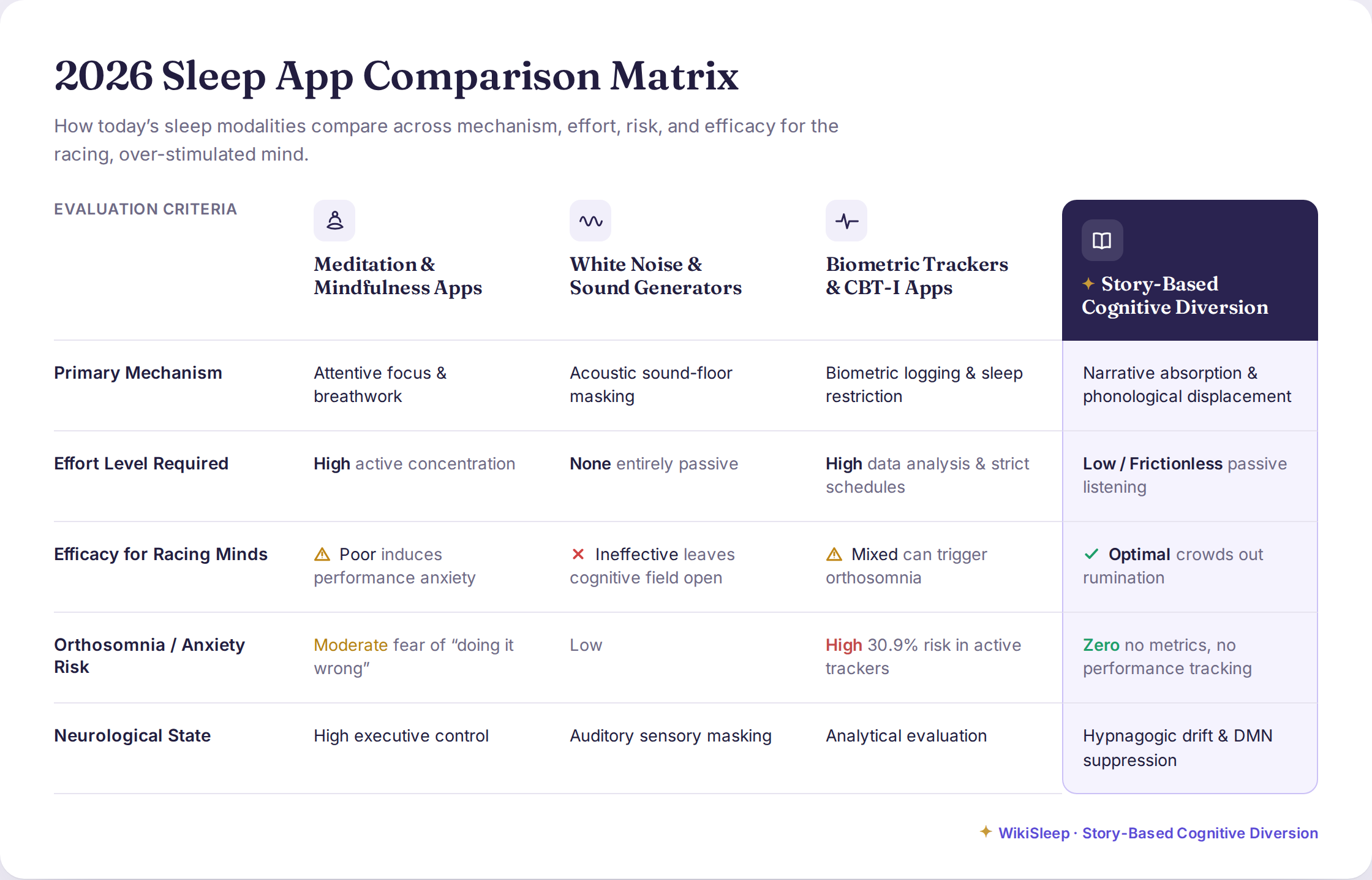
2026 Sleep App Comparison Matrix
To illustrate how these modalities stack up, the following benchmark compares their mechanisms, risks, and efficacy for modern consumers:
The Neuroscience: How Cognitive Diversion Quiets the Brain
The clinical efficacy of Cognitive Diversion rests on three core neurocognitive pillars that directly counteract bedtime anxiety.
First, it suppresses the Default Mode Network (DMN). When lying in a quiet, dark room, the DMN—responsible for future planning and self-referential rumination—spontaneously spikes, producing racing thoughts. Structured, low-stakes auditory narratives pull blood flow away from the DMN toward auditory processing regions.
Second, it blocks the Phonological Loop. Working memory processes internal speech via this single-channel verbal pathway. You cannot internally verbalize anxious thoughts while simultaneously decoding incoming spoken language. A gently narrated story occupies this loop, blocking worry at its linguistic root (Simply Psychology).
Finally, it triggers Somnolent Information-Processing. Developed by cognitive scientist Dr. Luc P. Beaudoin, this theory shows that the human brain continuously monitors its own thought patterns. Fragmented, visually descriptive, neutral narrative imagery mimics natural hypnagogic micro-dreaming, signaling to subcortical sleep switches that cognitive duties have ceased and it is safe to sleep (BBC Future).
Why WikiSleep Leads the Cognitive Diversion Revolution
As consumer demand shifts away from generic mindfulness tools, WikiSleep has emerged as the premier sleep story app engineered entirely around the scientific principles of Cognitive Diversion.
Rather than repurposing traditional audiobooks—which often contain cliffhangers, dramatic tension, and inconsistent vocal cadences that stimulate dopamine—WikiSleep utilizes calm biographical narratives, historical deep dives, geography, and folklore. These subjects are interesting enough to capture a racing mind's attention, yet emotionally neutral enough to prevent arousal.
By functioning as an audio-first, screen-free sanctuary, WikiSleep eliminates the "sleep effort" trap entirely. There are no biometric scoring dashboards to induce orthosomnia, and no complex breathing counts to remember. For individuals seeking a better sleep app that requires zero performance pressure, WikiSleep offers calibrated psycholinguistic narration designed specifically to nudge the brain into restful hypnagogic imagery.
Conclusion: The Future of Sleep is Passive Engagement
The 2026 data is clear: forcing an overactive mind to sit in silence is counterproductive. As the 2026 Digital Sleep Wellness Report states, "Asking a racing brain to focus on silence is like telling someone having a panic attack to 'just relax.' Story-based Cognitive Diversion works because it gives the brain an effortless job: listening."
For those struggling with nighttime anxiety or an endless inner monologue, acoustic masking and biometric grading are no longer sufficient. The path to reliable, sound sleep lies in gentle cognitive redirection—proving that sometimes, the best way to quiet the mind is to simply tell it a good story.