Falling into a deep sleep is an active, neurobiological process governed by continuous shifts in cortical frequencies, not a sudden on-off switch. For millions of adults experiencing pre-sleep cognitive hyperarousal, high-frequency beta waves (13–30 Hz) dominate the prefrontal cortex at bedtime. This neural state locks the brain into analytical "threat-monitoring" loops that significantly delay sleep onset.
Recent neuroscientific research into acoustic neuromodulation reveals a powerful non-pharmacological solution: paced nonfiction audio. By utilizing steady vocal prosody and structured spoken-word narratives, specific types of audio can act as a bridge across brainwave states. This guide explores the science behind sleep architecture and how cognitive diversion systematically shifts the brain from waking hyperarousal into restorative delta slow-wave sleep.
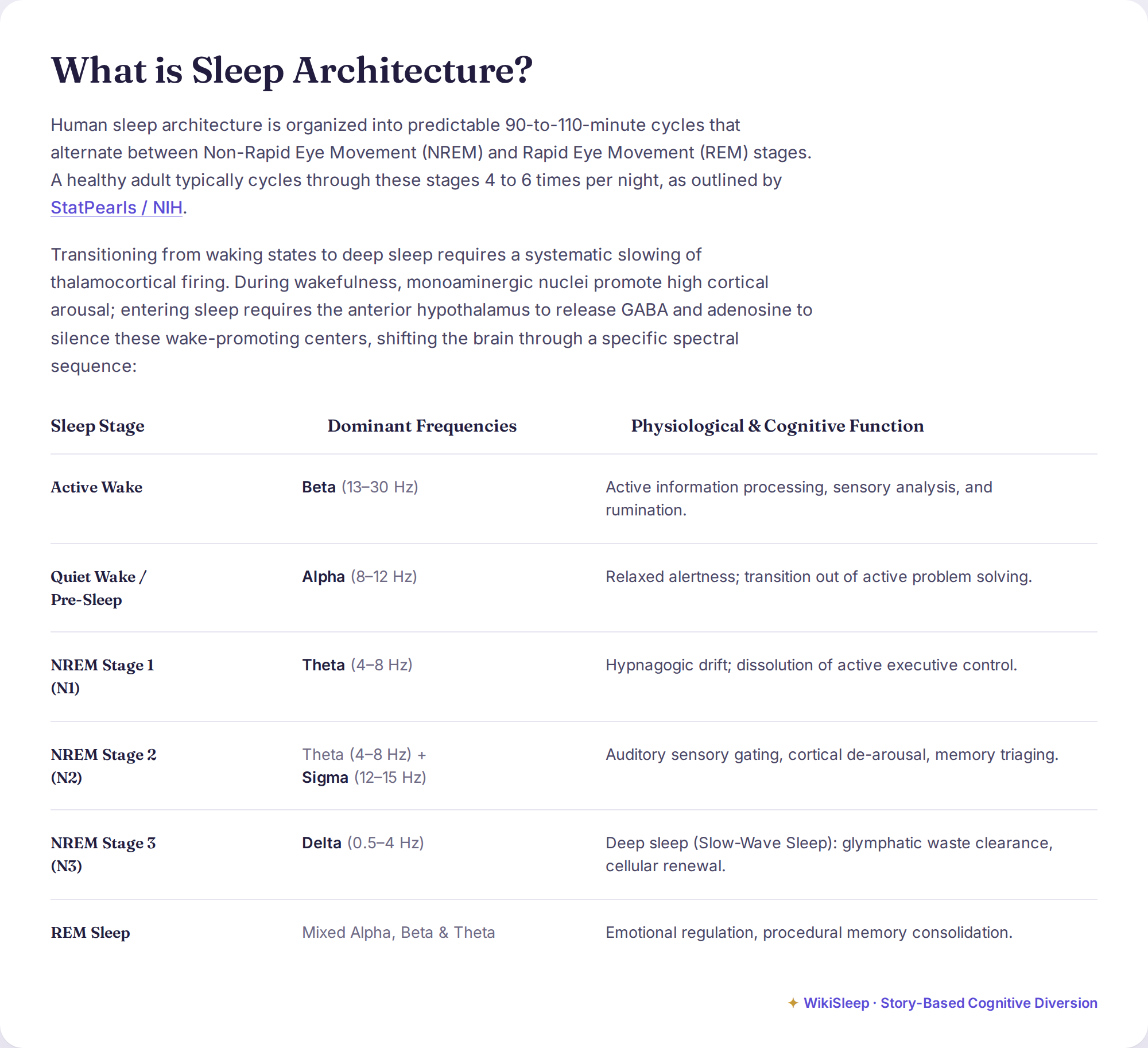
What is Sleep Architecture?
Human sleep architecture is organized into predictable 90-to-110-minute cycles alternating between Non-Rapid Eye Movement (NREM) and Rapid Eye Movement (REM) stages. A healthy adult typically cycles through these stages 4 to 6 times per night, as outlined by StatPearls / NIH.
Transitioning from waking states to deep sleep requires a systematic slowing of thalamocortical firing. During wakefulness, monoaminergic nuclei promote high cortical arousal. Entering sleep requires the anterior hypothalamus to release GABA and adenosine to silence these wake-promoting centers, shifting the brain through a specific spectral sequence:
The Pre-Sleep Barrier: Beta Hyperarousal and the Default Mode Network
When the lights go out and visual input ceases, the brain's Default Mode Network (DMN) often hyperactivates. For individuals with sleep-onset latency issues, the brain's "phonological loop"—our internal monologue—engages in retrospection, planning, and somatic monitoring.
This creates the "Sleep Paradox." Conscious effort to force sleep actually stimulates the Sleep Onset Control System (SOCS). When the brain detects structured, threat-evaluating thoughts, it registers an evolutionary need for vigilance, keeping cortical networks locked in high-frequency beta oscillations, a mechanism explored in recent WikiSleep Research. Survey data underscores this widespread issue: 68% of U.S. adults struggle with sleep at least once per week due to nighttime rumination, contributing to a massive $411 billion annual cost to the U.S. economy.
How Audio Engineered for Deep Sleep Employs Cognitive Diversion
To bypass the Sleep Paradox, cognitive scientists emphasize a technique known as Cognitive Diversion (or Serial Diverse Imagining). Pioneered by Dr. Luc P. Beaudoin at Simon Fraser University, the method posits that sleep onset requires disrupting organized, analytical mentation (BBC Future).
Paced nonfiction audio leverages this perfectly. By feeding the brain a steady stream of neutral, low-stakes narrative, the phonological loop is fully occupied without triggering emotional arousal (The Conversation). The specific acoustic features of audio designed for deep sleep include:
Slowed Cadence: Dropping vocal delivery from a conversational 150 words per minute down to 100–115 WPM provides temporal anchors that physically slow respiratory and cardiac rates.
Monotone Prosody: Avoiding emotional inflections prevents auditory-evoked K-alpha arousals.
Parasympathetic Neuromodulation: Predictable acoustic inputs elevate vagal tone, triggering heart rate deceleration and supporting the shift from sympathetic arousal to parasympathetic rest (Frontiers in Neuroscience).
Clinical trials have quantified this efficacy. A 2024 randomized controlled crossover trial evaluating phase-locked acoustic stimulation found that weekly average sleep onset latency was reduced by 29.3% among individuals with chronic sleep-onset difficulties (Bressler et al., Scientific Reports, 2024). Furthermore, recent 2025 clinical data in medRxiv established that baseline pre-sleep alpha and theta power strongly predict subsequent Slow-Wave Activity enhancement when acoustic interventions are used.
Step-by-Step: Guiding Brain Architecture Down the Spectrum
Properly engineered audio naturally walks the brain through the necessary stages of electrophysiological de-arousal.
Step 1: Beta Quieting & Alpha Induction (Pre-Sleep to N1)
As paced nonfiction audio occupies working memory, high-frequency beta waves diminish. Posterior alpha rhythms (8–12 Hz) emerge, signaling cortical de-escalation. As the body relaxes, alpha yields to diffuse theta waves (4–8 Hz), marking the entry into N1 sleep.
Step 2: Thalamocortical Gating (N2 Stage)
In N2 sleep, the brain generates sleep spindles (12–15 Hz sigma bursts) and K-complexes (MDPI Brain Sciences). These serve as electrophysiological filters, decoupling the cortex from external acoustic signals. Paced audio provides a consistent soundscape, ensuring sudden ambient noises don't trigger cortical awakenings during this vulnerable transition.
Step 3: Delta Synchronization (N3 Deep Sleep)
Reaching deep, deep sleep (the N3 stage) is characterized by synchronized slow oscillations (<1 Hz) and delta waves (0.5–4 Hz). Research by Ngo et al. in Neuron demonstrated that auditory stimulation locked to the "up-state" of slow oscillations amplifies delta wave amplitude. During this period, the brain's glymphatic system expands by 60%, allowing cerebrospinal fluid to flush out metabolic byproducts like amyloid-beta and tau proteins.
Clinical nap protocols confirm that auditory acoustic stimulation at slow frequencies significantly shortens the latency to reach N3 slow-wave sleep compared to non-acoustic conditions (Scientific Reports, 2024). Longitudinal trials have also shown these acoustic interventions lead to robust increases in slow-wave delta power and memory consolidation in older adults (Nature Communications Medicine; Frontiers in Sleep, 2024).
Step 4: Supporting the REM Cycle
Slow-wave sleep serves as the physiological foundation for the rest of the night. As the brain progresses through each REM cycle, periods of N3 deep sleep gradually shorten while REM intervals lengthen. To optimize overall sleep, REM sleep must be preceded by robust slow-wave delta sleep in early cycles, which stabilizes the neurochemical conditions required for restorative dream memory processing and emotional recalibration.
The "Goldilocks Zone" of Acoustic Intervention
Not all audio impacts sleep architecture equally. Traditional interventions often fall on opposite ends of a spectrum, missing the optimal cognitive load:
Static White Noise: Provides zero cognitive load. While it masks ambient sound, it leaves working memory under-stimulated, allowing the DMN to wander freely into anxiety loops.
Dramatic Fiction or Podcasts: Presents a high cognitive load. High-stakes narratives trigger dopamine and norepinephrine release, keeping cortical beta waves highly active.
Digital sleep platforms like WikiSleep operate in the ideal "Goldilocks Zone." By utilizing calm historical and biographical nonfiction, the content is engaging enough to displace intrusive thoughts but emotionally neutral enough to permit natural hypnagogic drift. Because this story-based Cognitive Diversion requires zero active effort, it bypasses performance anxiety entirely, a massive advantage over active meditation practices for those with insomnia.
Conclusion
Transitioning the brain from wakeful beta states to restorative delta waves is an intricate dance of neural synchronization. By utilizing paced nonfiction audio, individuals can effectively quiet the Default Mode Network and support their natural sleep architecture. Whether the goal is improving sleep onset, extending periods of deep sleep, or ensuring a balanced, high-quality REM cycle, scientifically structured auditory interventions represent a proven, non-pharmacological pathway to better rest and cellular recovery.