Physical exhaustion is no longer a guarantee of a restful night. For many high-achieving professionals and chronic overthinkers, climbing into bed physically exhausted only to find their brain shifting into a hyper-alert state is a nightly battle. This "tired-but-wired" paradox is a state of pre-sleep cognitive hyperarousal where the brain continues running analytical problem-solving loops in the absence of external sensory cues. Rather than relying on traditional meditation to force relaxation, neuroscience points to a more effective solution: narrative anchoring. By engaging the brain with low-stakes cognitive diversion, you can successfully bypass sleep anxiety and fall asleep effortlessly.
What is the Tired-but-Wired Dilemma?
The feeling of being physically drained yet mentally hyper-alert stems from a failure of the brain's neural downshifting process. When sensory input drops to near zero in a dark, quiet bedroom, the brain's Default Mode Network (DMN)—the neural circuit responsible for self-referential thought, future simulation, and retrospective analysis—often becomes hyperactive.
Recent neuroimaging research demonstrates that insomnia and delayed sleep onset are directly mediated by disruptions in large-scale brain networks. In individuals with chronic sleep disturbance, the DMN fails to suppress its activity during pre-sleep resting states, allowing the mind to cycle through unresolved tasks and worries. Studies highlight that this hyperconnectivity in the DMN is a primary driver of the inability to transition into sleep.
Furthermore, an August 2026 magnetoencephalography study published in CNS: Neuroscience & Therapeutics found that individuals with insomnia display heightened cortical excitability during the evening. In hyperaroused sleepers, the brain possesses a flattened control energy landscape, meaning it effortlessly drifts between worst-case scenarios and daytime anxieties unless provided with structured external input.
Why Traditional Mindfulness Backfires for High Performers
Standard wellness advice routinely prescribes mindfulness meditation, breath counting, or silent body scans to quiet your mind and get to sleep. However, for driven, analytical individuals, these conventional silence-based techniques frequently aggravate pre-sleep anxiety due to three well-documented neuro-psychological traps.
Relaxation-Induced Anxiety (RIA)
Relaxation-Induced Anxiety refers to a paradoxical surge in subjective anxiety and physiological arousal during deliberate relaxation practices. According to the Contrast Avoidance Model explored in the Journal of Affective Disorders, highly anxious individuals often maintain worry as a protective buffer against unexpected emotional spikes. Forcing immediate relaxation makes the brain feel emotionally unprotected. In fact, up to 53% of anxious individuals experience heightened tension when attempting traditional relaxation protocols, as detailed in WikiSleep's neurobiology review.
Ironic Process Theory
Formulated by Harvard psychologist Daniel Wegner, Ironic Process Theory (often called "The White Bear Effect") posits that attempting to suppress thoughts initiates an automatic monitoring process that scans working memory to verify the unwanted thought hasn't returned. Forcing the brain to "empty itself" at bedtime triggers this automatic neural monitor, which heightens sensitivity to the exact stressors you are trying to clear from your sleep mind.
Interoceptive Hypervigilance
Directing attention inward to monitor your breathing rate or pulse invites the amygdala to treat minor physiological fluctuations as threat cues. As Stanford University clinical psychologist Dr. Natalie Solomon notes, treating sleep like a daytime performance metric turns relaxation into performance anxiety. Sleep is an involuntary biological process that fiercely resists direct conscious intervention.
What is Narrative Anchoring?
Narrative Anchoring (a core application of Cognitive Diversion) replaces active, introspective effort with passive, low-stakes auditory tracking. Rather than attempting to empty the mind, the sleeper gives the brain an external, gently engaging narrative that consumes working memory bandwidth without triggering emotional arousal or executive problem-solving.
This technique disarms the brain's Sleep Onset Control System (SOCS). Introduced by cognitive scientist Dr. Luc P. Beaudoin, the SOCS continuously evaluates whether it is biologically safe to transition into unconsciousness. Coherent, problem-solving thoughts signal that active threat monitoring is necessary. In contrast, listening to descriptive, low-stakes narratives signals that higher executive control can relinquish its duties, activating the biological cascade required to drift off to sleep.
Clinical research supports this mechanism. Functional neuroimaging shows that descriptive storytelling shifts neural activation away from DMN self-referential circuits and toward the auditory and language cortices, effectively suppressing intrusive pre-sleep thoughts.
Core Elements of Somnolent Narrative Architecture
Not all audio is conducive to sleep. While broadband white noise masks ambient sound, it lacks semantic richness, allowing a busy mind to continue wandering. Conversely, intense audiobooks or podcasts trigger predictive dopamine spikes.
To effectively lower sleep latency, sleep audio must follow specific structural criteria:
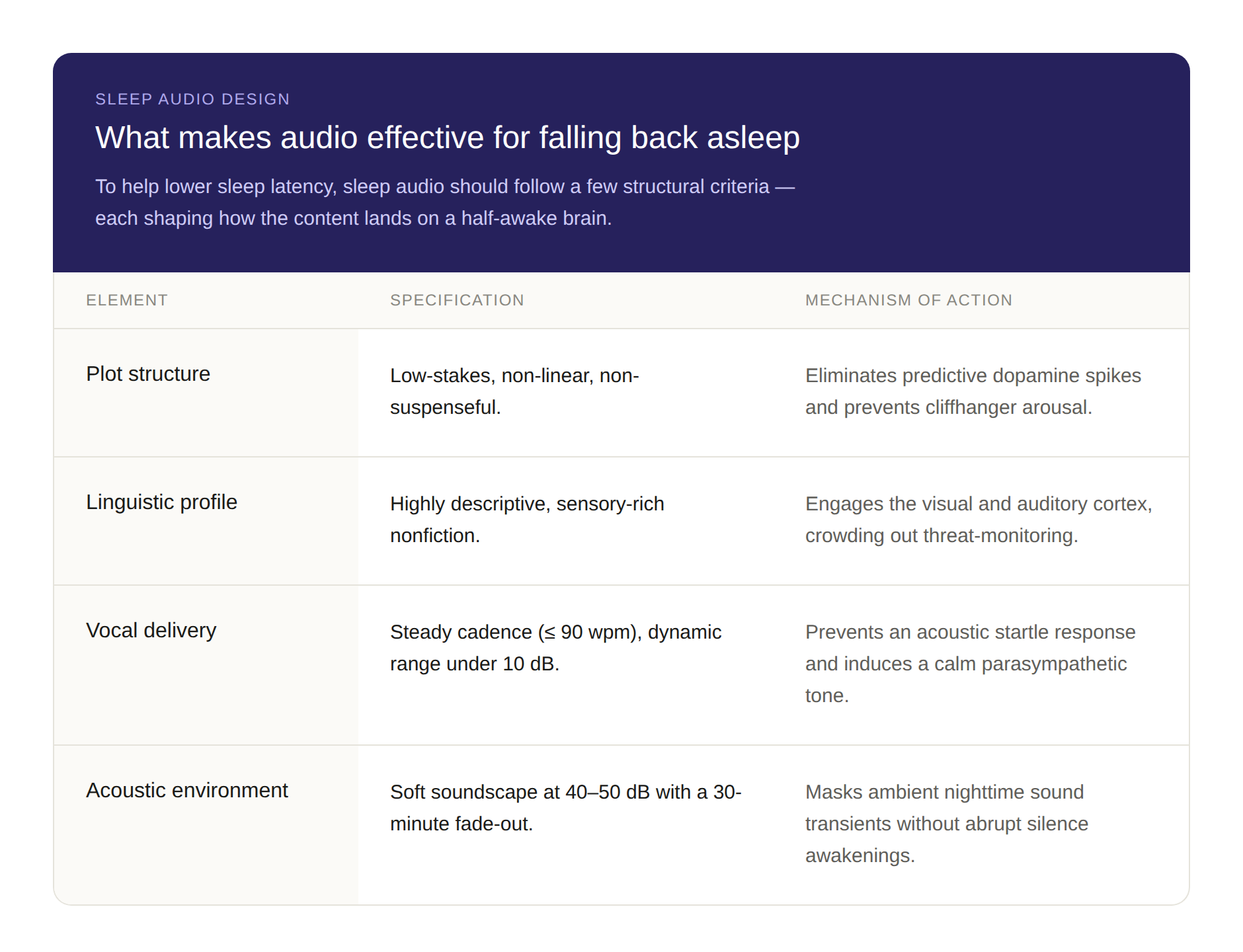
Recognizing the gap between active mindfulness and raw white noise, digital wellness platforms have evolved to meet this neurological need. WikiSleep, a mobile-first sleep-wellness app, utilizes story-based Cognitive Diversion to guide the transition from hyperarousal to rest. By offering calm, narrated nonfiction and creative stories, WikiSleep acts as a passive, frictionless anchor that neutralizes DMN rumination without requiring the discipline of meditation.
The Economic and Cognitive Toll of Pre-Sleep Arousal in 2026
The scale of cognitive hyperarousal is expanding, heavily impacting high-output professionals. The AASM Sleep Prioritization Survey reports that 68% of Americans experience disrupted sleep due to anxiety, with 80% of Gen Z and 75% of Millennials disproportionately affected.
According to Amerisleep's Sleep Anxiety Index, 92% of U.S. adults lose sleep to anxiety, with 41% experiencing peak distress between 10:00 PM and midnight. This translates to an average of 14 lost or impaired workdays per worker annually, or an estimated $2,950 per worker in lost productivity. For leaders, the pressure is even higher; the BCG CEO Insomnia Index highlights that executive job stress averages 66.7 out of 100, driving severe sleep onset delays.
While approximately 15.4% of adults struggle to sleep daily, clinical behavioral health data reveals that physical pathology accounts for only 20–30% of these cases. The remaining 70–80% are driven purely by pre-sleep cognitive hyperarousal.
Conclusion: A New Paradigm for Rest
Nighttime overthinking in high performers is rarely a failure of willpower or physical tiredness; it is a state of pre-sleep cognitive hyperarousal. If you are exhausted from searching for ways to "help me get to sleep," the solution isn't to try harder to empty your thoughts. Instead, lean into the science of Cognitive Diversion. By swapping silent frustration for the passive engagement of narrative anchoring, you can successfully bypass your brain's rumination loops, signal safety to your nervous system, and finally reclaim your rest.