Waking up at 3:00 AM with a racing mind is one of the most frustrating experiences for anyone dealing with disruptive sleep insomnia. While standard advice often pushes breathing exercises or mindfulness meditation to help you return to rest, clinical neurocognitive research reveals a significant flaw in this approach. In the middle of the night, actively trying to force your brain into a relaxed state frequently triggers the opposite effect: a spike in anxiety and cognitive friction that keeps you wide awake. The most effective method to get to sleep and stay asleep is not effortful meditation, but passive narrative cognitive diversion.
What is Sleep Maintenance Insomnia?
Sleep maintenance insomnia is the persistent inability to stay asleep or return to rest after waking up during the night. While many people associate insomnia exclusively with the inability to fall asleep at bedtime, difficulty maintaining sleep is actually far more prevalent.
According to the America Insomnia Survey published in Sleep, difficulty maintaining sleep is the single most common symptom of insomnia, reported by 61.0% of individuals with the condition. Furthermore, large-scale population data published in Sleep Medicine indicates that 35.5% of the general population experiences nocturnal awakenings at least three nights per week. This specific sleep disruption is disproportionately tied to daytime functional impairment, elevated cardiovascular stress, and chronic anxiety.
Why the 3:00 AM Awakening Happens
To understand what can cause insomnia during the middle of the night, it is essential to look at human sleep architecture. Nocturnal awakenings around 3:00 AM are driven by a biological crossroads of sleep drive and circadian rhythmicity.
During the first three to four hours of the night, human sleep is dominated by slow-wave deep sleep, which systematically metabolizes accumulated adenosine (the chemical that makes us feel sleepy). By 3:00 AM, up to 80% of this homeostatic sleep pressure has dissipated. At the exact same time, as documented in Endotext and Sleep Medicine Reviews, the body's Hypothalamic-Pituitary-Adrenal (HPA) axis initiates its early morning ramp-up, increasing cortisol pulsatility.
With sleep pressure low and cortisol naturally rising, the brain transitions into lighter REM and Stage 2 (N2) sleep. In this vulnerable window, even a brief micro-awakening can instantly cascade into full physiological arousal.
The Problem with Mindfulness and Effortful Relaxation at 3 AM
When faced with middle-of-the-night wakefulness, the standard behavioral prescription is often to "clear the mind" through breath awareness or body scans. However, clinical literature illustrates why these active cognitive exercises frequently backfire.
Relaxation-Induced Anxiety (RIA)
Focusing intently on physiological sensations in a dark, silent room often triggers sympathetic arousal rather than calm. According to research reported by Therapy in a Nutshell, Relaxation-Induced Anxiety (RIA) affects between 15% and 30% of individuals. For those with hypervigilant nervous systems, the quiet focus required by meditation amplifies internal danger signals.
Ironic Process Theory
Formulated by social psychologist Daniel Wegner, Ironic Process Theory explains that deliberately attempting to suppress conscious thoughts involves an intentional operating process (trying to relax) and an unconscious monitoring process (checking to see if you are relaxed yet).
At 3:00 AM, when your prefrontal cortex is fatigued, this monitoring process dominates. Every time you ask yourself if you are falling asleep, you activate cortical networks that reset wakefulness. As noted by Dr. Laurie Marbas in The Sleep Paradox, insomnia is often not a deficit of sleep drive, but an excess of wakefulness generated by the sheer effort to sleep.
How Story-Based Cognitive Diversion Helps You Fall Asleep
When suffering from nocturnal insomnia, how to fall asleep effectively requires removing cognitive effort entirely. The neurocognitive framework for this is Somnolent Information-Processing (SIP) Theory, pioneered by cognitive scientist Dr. Luc P. Beaudoin.
Beaudoin notes that healthy pre-sleep brain activity is characterized by fragmented, non-goal-oriented, and emotionally neutral imagery. People with insomnia, conversely, engage in "insomnolent mentation"—analytic sense-making and problem-solving.
The solution is Narrative Cognitive Diversion. By listening to passive, varied auditory imagery—such as calm nonfiction storytelling—the brain is disrupted from its structured thinking. In a recent 2026 analysis for BBC Future, sleep specialist Dr. Alanna Hare observed that this mechanism deploys a dual action: it pushes away cognitive arousal by occupying working memory, and it pulls the brain toward sleep by mimicking the natural, fragmented micro-dreams of Stage 1 (N1) hypnagogia.
Clinical Evidence for Audio Sleep Tools
A multi-arm randomized controlled pilot trial published in Sleep examined the efficacy of app-based audio tools, specifically narrated stories and music. The trial demonstrated significant reductions in nocturnal sleep disturbance, with massive effect sizes (Hedges' g = 0.92 to 1.09) compared to waitlist controls, and an 82.1% overall intervention satisfaction rate.
The 4-Step 3 AM Cognitive Reset Protocol
When nocturnal waking strikes, use this evidence-based clinical protocol to effortlessly restore sleep without triggering cognitive friction:
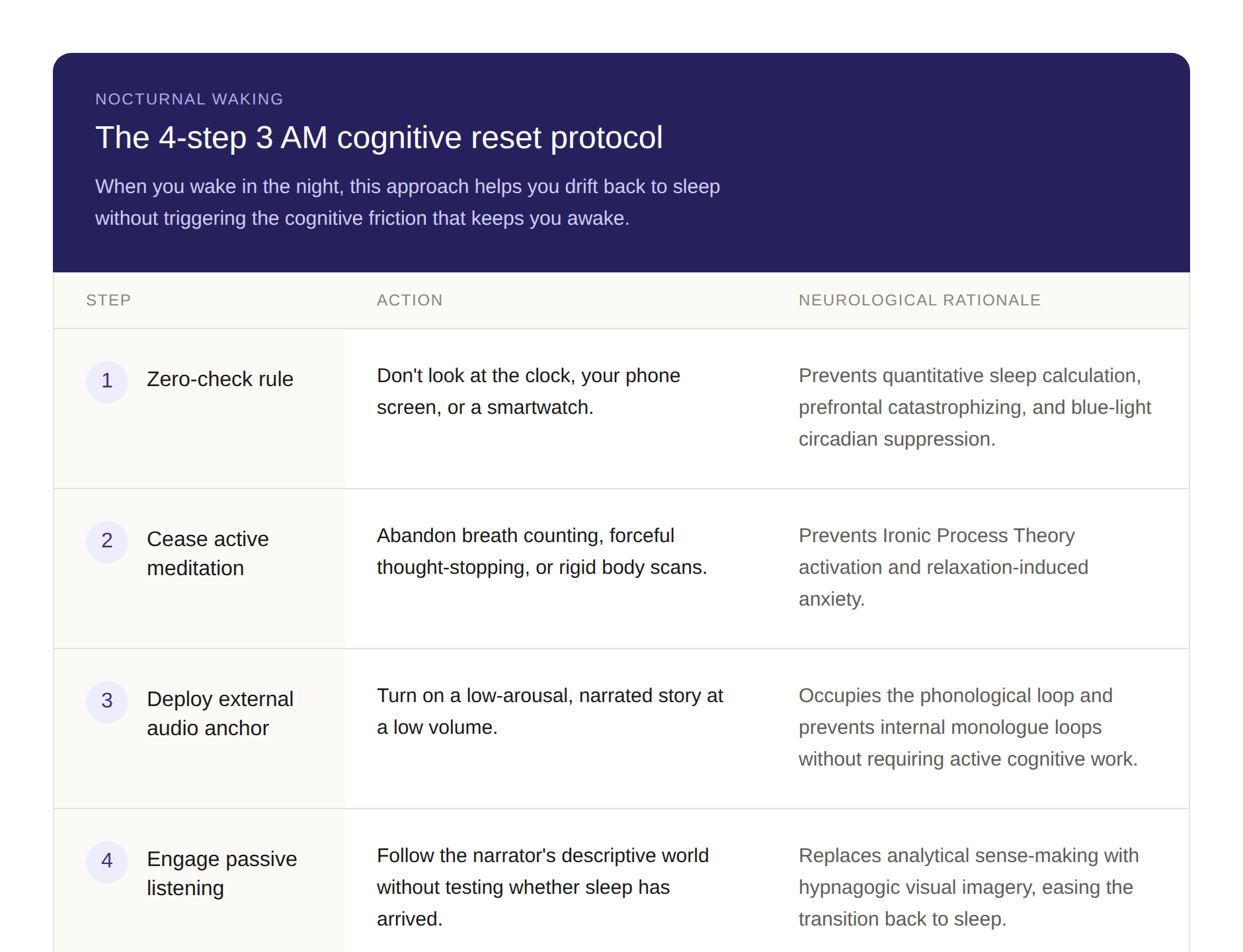
How WikiSleep Addresses the Nocturnal Insomnia Gap
Most digital wellness platforms rely heavily on instructional mindfulness, asking hyperaroused users to actively focus and regulate their attention. For middle-of-the-night panic, this demands executive function at the exact moment the brain requires passive drift.
Platforms like WikiSleep address this specific cognitive bottleneck by offering a frictionless, non-meditation format. Through audio journeys, historical biographies, and calm nonfiction narratives engineered with steady pacing and rich imagery, listeners experience effortless cognitive displacement. By replacing anxious internal monologues with interesting yet tranquil storytelling, WikiSleep provides a powerful external anchor tailored specifically to guide listeners through 2:00 AM to 4:00 AM awakenings back into consolidated rest.
Conclusion
Sleep maintenance insomnia at 3:00 AM is rarely an issue of physical exhaustion; it is an issue of pre-sleep cognitive hyperarousal occurring just as homeostatic sleep drive drops. In this vulnerable state, trying to actively meditate triggers a cognitive monitoring process that keeps the prefrontal cortex wide awake.
By leveraging low-effort, story-based cognitive diversion, you provide your brain with a passive external anchor. When you replace the frustrating performance pressure of meditation with engaging but tranquil audio storytelling, you effectively neutralize nighttime overthinking, helping you naturally get to sleep and stay asleep.