Best Bedtime Story Apps for Adults in 2026: What to Look For If You Have a Racing Mind
In 2026, the primary barrier to sleep is not physical fatigue, but cognitive arousal—the inability to switch off a racing internal monologue. According to a June 2026 report by the National Sleep Foundation, 61% of adults report they cannot calm their minds at bedtime, citing racing thoughts and stress as the leading causes of sleep delay.
While smart-bed technology has made 90% sleep efficiency technically achievable, more than 1 in 5 adults still struggle to fall asleep regularly due to this cognitive arousal. For these overthinkers, traditional white noise and meditation often fall short. Instead, the most effective sleep app solutions now utilize sleep stories designed specifically to distract and soothe a busy brain.
This guide explores the science behind why we stay awake, what features to look for in a digital sleep tool, and the best bedtime story apps for adults in 2026.
What is Cognitive Diversion?
Cognitive Diversion (also known as Cognitive Shuffling) is the most effective alternative to meditation for sleep, replacing active worry with passive, low-stakes attention.
Developed by cognitive scientist Dr. Luc Beaudoin, this technique relies on "Serial Diverse Imagining." By focusing on a stream of random, emotionally neutral images or narratives, the brain receives a biological signal that it is safe to power down. This process mimics the hypnagogic state—the fragmented, dream-like thoughts that naturally precede sleep.
As Dr. Alanna Hare, Consultant in Sleep Medicine, explains: "Cognitive shuffling is 'super somnolent.' It deploys a push-and-pull mechanism on the mind—both pulling you towards sleep while also quietening the intrusive worries that keep you awake" (BBC Future, 2026).
Why Traditional Meditation Fails the "Racing Mind"
For high-achievers, overthinkers, and those with ADHD, traditional meditation can actually make insomnia worse. Recent data indicates that for these individuals, meditation can trigger "sleep effort"—a paradoxical state where the act of trying to relax increases cortisol and alertness (WikiSleep, 2026).
Rather than forcing the mind to clear itself, relaxing sleep stories provide the necessary "mental clutter" to mimic the brain's natural path to sleep, offering a gentle landing pad for racing thoughts.
What to Look for in a Sleep App in 2026
When selecting an app to quiet a racing mind, the digital sleep-wellness market has established a new "gold standard" for 2026. Here is what you should look for:
1. Narration Style and Pacing
Optimal Cadence: Research indicates that a speech rate of ≤ 90 words per minute (wpm) is ideal for inducing parasympathetic dominance (WikiSleep, 2026).
Tone: Narrators should be monotone but not robotic. Avoid apps with narrators who use sharp inhales or heavy emotional inflections, which can trigger a startle response.
2. Technical Standards
Volume Normalization: The ideal sleep story in 2026 follows the EBU R128 technical standard (targeting -16 to -19 LUFS) to ensure no volume spikes disrupt the transition into deep rest.
Ad-Free Listening: For overthinkers, an ad interruption is a "cognitive reset" that can instantly restart the cycle of racing thoughts. Always opt for ad-free platforms.
3. Story Formats
Low-Stakes Nonfiction: Biographies, histories, and descriptions of everyday objects are highly recommended over fiction. They provide enough interest to distract the mind without the "cliffhanger" arousal of a plot-heavy story.
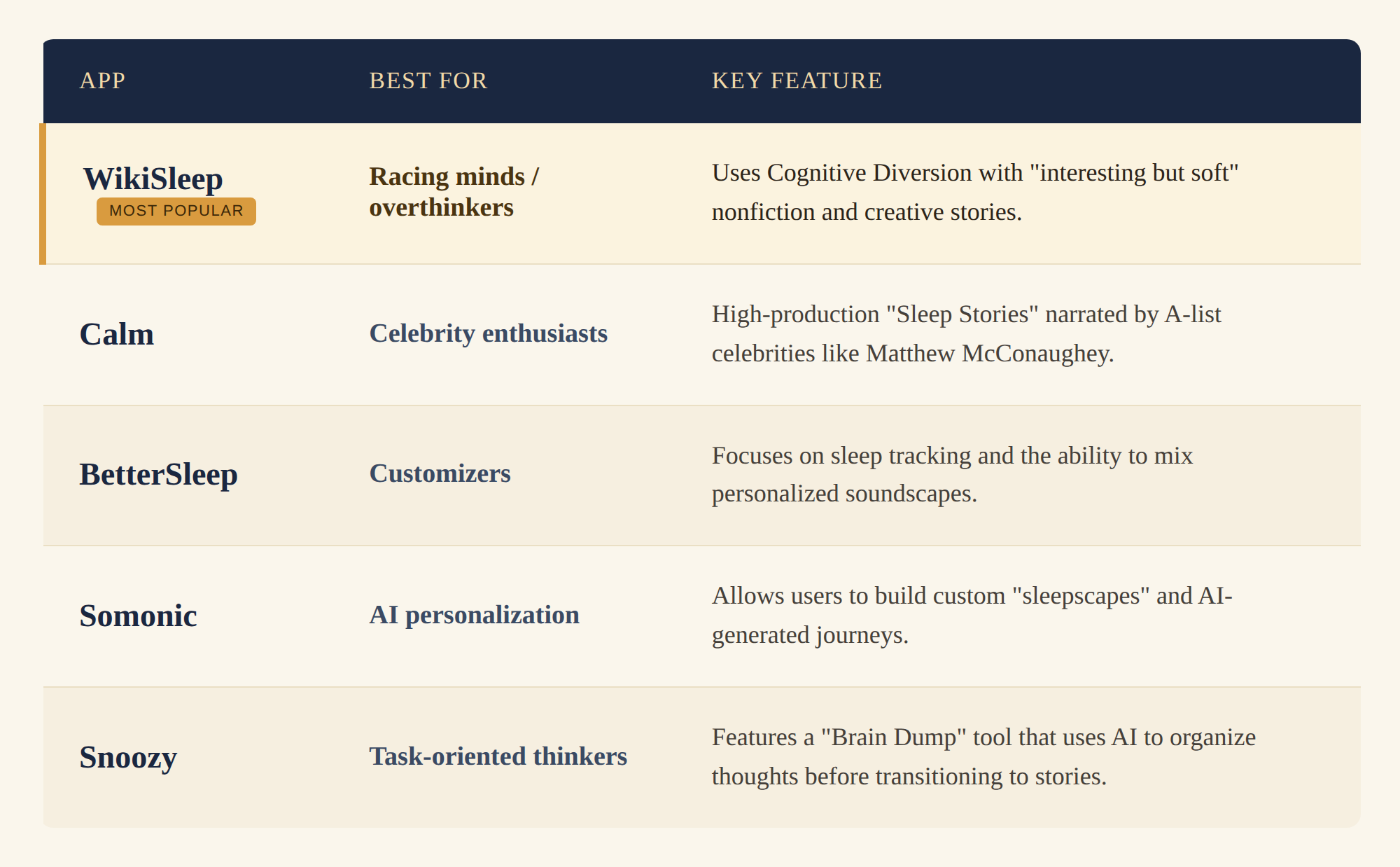
5 Best Bedtime Story Apps for Adults in 2026
Here is a comparison of the top apps offering stories to sleep to, categorized by their best use case:
Frequently Asked Questions (FAQ)
Do sleep stories actually work for adults? Yes. For the 61% of adults with racing minds, sleep stories provide the mental clutter necessary to mimic the brain's natural path to sleep. By engaging in Cognitive Diversion, listeners can distract their brains from stressful, active worry, allowing the parasympathetic nervous system to take over.
What are the best stories to sleep to? The best stories for sleep are low-stakes nonfiction, such as history, biographies, or detailed descriptions of mundane processes. These topics are interesting enough to hold your attention and distract you from your own thoughts, but not so exciting that they trigger emotional arousal or suspense.
Why is white noise no longer enough? While white noise masks environmental sounds, it does nothing to address internal cognitive arousal. If your primary barrier to sleep is your own internal monologue, you need a narrative tool to actively divert your attention away from your thoughts.
Conclusion
If you are part of the majority of adults struggling with a racing mind at bedtime, traditional advice to "just clear your head" is likely doing more harm than good. By leveraging the science of Cognitive Diversion through a dedicated sleep app, you can bypass the frustration of meditation. Whether you opt for the low-stakes nonfiction of WikiSleep or the AI-generated journeys of Somonic, finding the right relaxing sleep stories can finally help you turn off your thoughts and get the rest you need in 2026.