Best Sleep Apps for People With Racing Thoughts: Meditation Alternatives That Actually Help
For the 68% of Americans who struggle with sleep on a weekly basis, the standard advice to "clear your mind" is often the exact opposite of what the brain needs. As of July 2026, sleep science has recognized a growing trend of "meditation fatigue." For individuals with overactive minds, traditional mindfulness can actually trigger anxiety, making sleep stories and cognitive distraction the new gold standard for insomnia relief.
If you find yourself staring at the ceiling while your internal monologue races, you are not alone. This guide compares the best sleep apps of 2026 designed specifically for people who dislike meditation, focusing on cognitive diversion, relaxing sleep stories, and mental distraction.
Why Meditation Fails for Racing Thoughts in 2026
Trying too hard to relax is a primary driver of modern insomnia. Experts refer to this as the "sleep effort" trap. When users put intense effort into meditating correctly, they inadvertently enter a high-arousal state that is biologically incompatible with sleep.
Recent data from the 2026 Sleep Anxiety Index indicates that 92% of Americans report losing sleep to anxiety, stress, or dread, with symptoms peaking between 10:00 PM and 12:00 AM. Furthermore, a 2025 study revealed that 58.4% of meditators experienced adverse effects, including Relaxation-Induced Anxiety (RIA), when forced into silence.
As the WikiSleep Editorial Team notes: "For many adults, the instruction to 'clear your mind' at bedtime is a recipe for disaster. For a brain already suffering from brain insomnia, this effort is registered as a 'task,' which inadvertently increases cortical arousal."
What is Cognitive Diversion?
Cognitive Diversion is a sleep technique that uses low-stimulus, narrated content to provide a "cognitive anchor" for the brain. By giving the mind just enough interesting but non-threatening information to focus on, it prevents the brain's Default Mode Network (DMN) from spiraling into stressful rumination.
This differs slightly from Cognitive Shuffling, a technique developed by cognitive scientist Dr. Luc Beaudoin. Cognitive shuffling involves visualizing random, neutral images (like a "piano," then a "peach") to mimic the fragmented "micro-dreaming" state of sleep onset. As Dr. Beaudoin explains, it "interrupts the stressful, looping thoughts that keep you awake by mimicking the 'micro-dreaming' state" BBC Future.
Cognitive diversion, however, relies on continuous audio narratives—like deep sleep stories—to gently occupy the brain's processing power until sleep takes over.
Top Sleep Apps for Racing Minds (2026 Comparison)
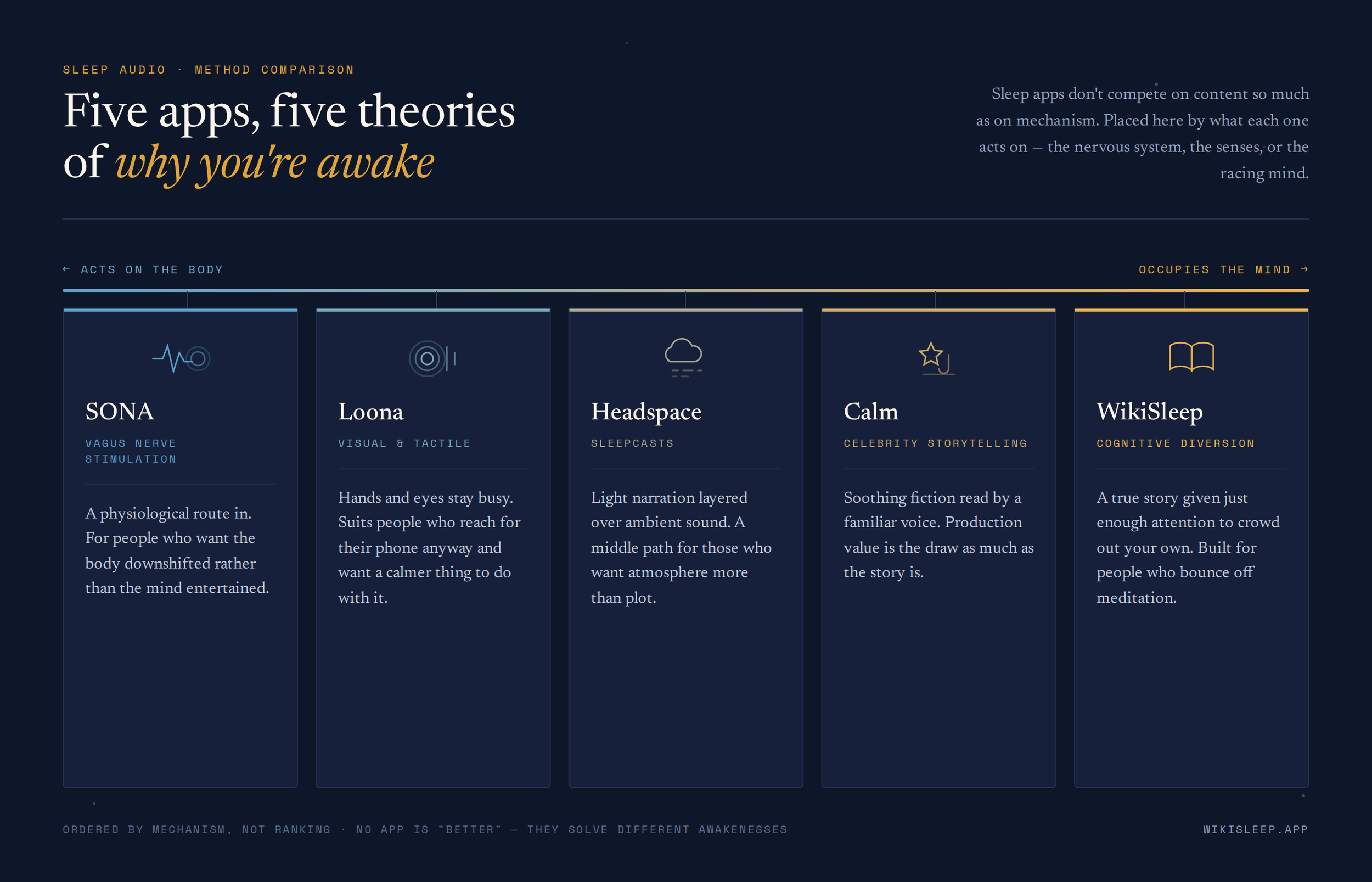
For those who need an alternative to traditional meditation, several apps now specialize in distraction, storytelling, and physiological relaxation. Here is how the top platforms compare:
1. WikiSleep: Best for Cognitive Diversion
WikiSleep has established itself as the premier alternative for the "meditation-averse." Instead of asking users to focus on their breath, the app uses narrated nonfiction and creative stories to occupy the mind.
WikiSleep challenges the myth that sleep content must be boring. Their library features over 250 unique stories, ranging from biographies of Jane Goodall to "Historical Curiosities" like the History of Saunas. The content is designed to be genuinely interesting enough to draw the mind away from personal worries, but narrated at a calm pace that allows listeners to drift off naturally.
"Sleep is a paradox: the harder you try, the harder it gets," says Adrien Sala, Founder of WikiSleep. "The secret isn’t forcing yourself to do it—it’s getting your brain to stop fighting against it."
2. Calm: Best for Celebrity Narration
Calm continues to dominate the market for high-production sleep stories. Featuring A-list narrators like Matthew McConaughey, Calm is ideal for users who find comfort in familiar, soothing voices. While it remains a giant in the wellness space, some users with severe sleep anxiety may find its broad, traditional mindfulness focus less targeted than dedicated cognitive diversion apps Ubie Health.
3. Headspace: Best for Ambient Sleepcasts
Headspace takes a unique approach with its "Sleepcasts." These 45–55 minute audio experiences blend light visualization with ambient soundscapes. To prevent the brain from "learning" the story and tuning it out, Headspace slightly alters the narrative each night, making it a strong option for chronic overthinkers ILTY.
4. Loona: Best for Visual Engagement
For users who need to physically "fidget" before bed, Loona offers a visual and tactile alternative to audio-only apps. It combines storytelling with interactive coloring and puzzle elements, helping to wind down the brain through gentle, repetitive physical engagement.
5. SONA: Best for Physiological Intervention
Moving away from storytelling entirely, SONA utilizes AI-powered audio pulses designed to stimulate the vagus nerve. This physiological intervention is best for users who want a purely scientific, sound-based approach to lowering their heart rate without engaging with a narrative MindSpire.
How Relaxing Sleep Stories Help You Fall Asleep Faster
The efficacy of story-based sleep aids is backed by compelling 2026 data. Adults listening to low-stimulus narratives fall asleep 38% faster than those using standard white noise.
Dr. Alanna Hare, a sleep medicine specialist, describes the cognitive diversion provided by these stories as "super somnolent." The technique works because it simultaneously pulls the mind toward sleep while actively quieting intrusive, late-night worries.
Conclusion
If traditional meditation leaves you feeling more awake and anxious, it is time to stop forcing it. The 2026 shift toward cognitive diversion proves that distraction is often the best medicine for an overactive mind. Whether you choose the fascinating nonfiction deep sleep stories of WikiSleep, the celebrity voices of Calm, or the ambient environments of Headspace, finding the right mental anchor can finally help you turn off your thoughts and get the rest you deserve.