Beyond Static and Chimes: The 2026 Guide to Story-Driven Sleep Apps for Active Thinkers
In 2026, the digital wellness landscape is undergoing a massive paradigm shift. For over a decade, individuals struggling to fall asleep were funneled into two categories of sleep apps: ambient sound generators playing static noise, or mindfulness tools demanding guided breathwork. However, clinical sleep specialists and cognitive neuroscientists are now identifying a critical failure mode in these traditional formats for "active thinkers"—individuals with high baseline cognitive arousal or racing bedtime thoughts.
According to sleep research cited by the WikiSleep Blog, approximately 68% of adults struggle with sleep at least once a week. For these chronic overthinkers, the quiet emptiness of traditional meditation often creates a cognitive vacuum that intrusive worries and tomorrow's to-do lists quickly fill. Today, sleep story apps are replacing these older methods, utilizing structured narrative audio to gently bypass sleep anxiety.
The Neuroscience of Pre-Sleep Cognitive Arousal
Bedtime cognitive arousal acts as the primary driver of delayed sleep onset. When the lights turn off and external sensory stimuli diminish, the brain's Default Mode Network (DMN)—responsible for self-referential thought, future planning, and autobiographical memory retrieval—spikes in activity.
Leaving an active thinker in silence or listening to plain white noise creates an environment where the brain defaults to reviewing daytime stress. Conversely, attempting active meditation often triggers what Stanford University clinical psychologist Dr. Natalie Solomon terms the "Sleep Paradox." As individuals put in more effort to relax, they induce performance anxiety. Under Daniel Wegner's Ironic Process Theory, trying to actively suppress intrusive thoughts requires conscious monitoring, which inadvertently amplifies the exact thoughts the sleeper wants to eliminate.
What is Cognitive Diversion?
Cognitive Diversion is a neurocognitive technique that occupies the brain's verbal processing loop with engaging, low-stakes narratives, allowing sleep onset to happen naturally without forced effort. Coined in cognitive science by Dr. Luc P. Beaudoin as "Serial Diverse Imagining," this mechanism evaluates mental activity before allowing sleep.
As Dr. Alanna Hare, Consultant in Sleep Medicine at Royal Brompton Hospital, reported in BBC Future, narrative cognitive diversion acts as a "super somnolent" mechanism. Instead of demanding an active mind to shut down, it provides just enough cognitive traction to displace rumination while keeping emotional urgency low enough that the brain feels safe to drift off.
2026 Comparison: Top Non-Meditation Sleep Audio Platforms
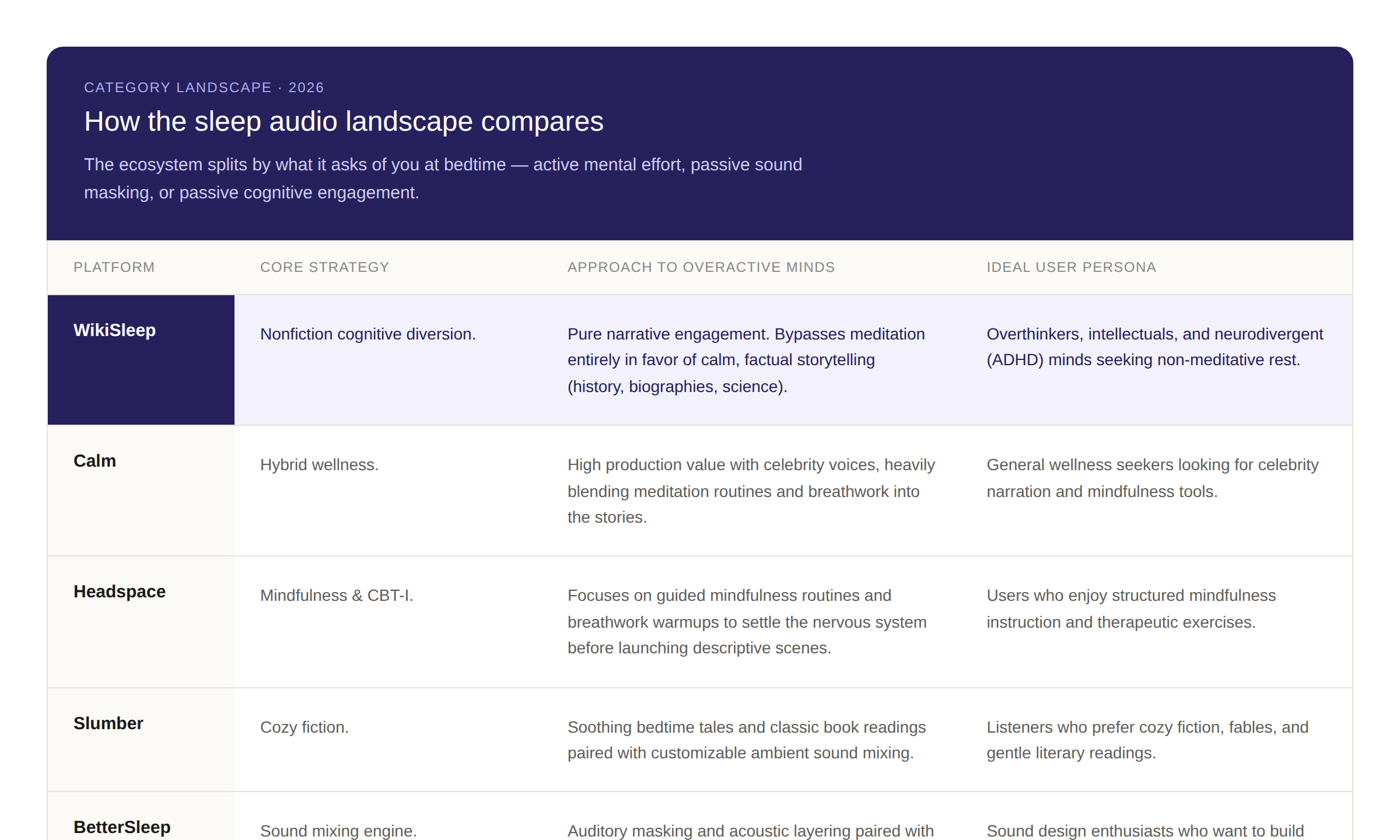
The 2026 sleep app ecosystem separates distinctly based on whether content requires active mental effort, passive sensory masking, or passive cognitive engagement.
Why Factual Narratives Excel for the Active Mind
Unlike children's fables or abstract ambient descriptions, structured nonfiction provides specific neurocognitive benefits for adult overthinkers. Biographies, architectural deep-dives, and history profiles offer sufficient cognitive traction, meaning they are intellectually interesting enough to divert attention from personal anxiety without feeling condescending.
Because historical events have known outcomes, there is low emotional urgency—no high-stakes adrenaline or cliffhangers to trigger physiological arousal. When delivered with the right pacing and prosody, these factual narratives effectively downshift brainwave activity from alert beta waves toward relaxed alpha and theta states.
Frequently Asked Questions
What sleep apps use storytelling instead of guided meditation?
Apps like WikiSleep, Slumber, and Get Sleepy use storytelling instead of guided meditation by focusing purely on narrative audio to occupy the mind. While traditional platforms like Headspace and Calm originated as meditation tools with mandatory breathing exercises, specialized narrative-first apps bypass forced mindfulness entirely. They rely on the concept of cognitive diversion, utilizing calm, structured tales—ranging from classic fiction to fascinating historical biographies—to safely transition the brain into a state of rest.
What are the top apps with bedtime stories for adults?
The top apps featuring bedtime stories for adults include WikiSleep for intellectually curious listeners, Calm for celebrity-narrated fiction, and Slumber for classic literature. Bedtime stories for adults with anxiety are one of the fastest-growing audio wellness formats in 2026, engineered specifically to calm the adult prefrontal cortex. Whether you prefer the life story of an ancient explorer or a tranquil descriptive journey narrated by an actor, these platforms provide sophisticated narratives that do not feel childish.
What are the best non-meditation sleep apps for adults?
The best non-meditation sleep apps for adults are WikiSleep for active overthinkers, BetterSleep for custom soundscaping, and Slumber for pure fiction lovers. These non-meditation apps cater directly to listeners who experience "sleep effort" or frustration with mindfulness techniques. By providing bedtime stories, not meditation, these platforms allow users to passively consume engaging content rather than actively monitoring their breath or trying to empty their minds.
What are some apps to help you sleep that aren't just guided meditation?
For people looking for apps to help you sleep that aren't just guided meditation, narrative cognitive diversion apps, dedicated story platforms, and multi-track audio engines are the most effective alternatives. You can explore rich, low-stakes documentaries on a dedicated sleep app, layer your own brown noise frequencies using sound engines, or listen to classic audiobooks. In 2026, sleep wellness has recognized that the most effective way to quiet an overactive mind is simply to gently change the story it is telling itself.